

















ADA compliant signage manufacturers produce accessible signs designed to help people identify rooms, facilities, and public spaces. COSUN SIGN manufactures custom metal room signs and ADA signs using stainless steel, aluminum, and brass, with options for raised tactile text, symbols, Grade 2 Braille, contrasting colors, and multiple mounting methods for commercial and public buildings.
What Are ADA Compliant Signs and How Do They Work?
ADA-compliant signs are accessibility signs designed to meet applicable requirements of the Americans with Disabilities Act (ADA) and relevant building codes. They support room identification and navigation for people with visual impairments and other accessibility needs.
An accessible sign may combine several features:
- Raised tactile characters: Raised letters and numbers allow information to be identified by touch.
- Grade 2 Braille: Contracted Braille communicates room names, numbers, and other identifying information.
- Visual contrast: Contrasting foreground and background colors help improve readability.
- Non-glare finishes: Matte or other suitable finishes reduce distracting reflections.
- Accessible placement: Installation height and location must follow applicable accessibility requirements.
The main advantages include improved accessibility, consistent room identification, easier wayfinding, and integration with architectural interiors.
Compared with traditional signs that rely exclusively on printed text, tactile ADA signs provide an additional way to access information through touch. However, not every directional or informational sign has identical requirements. The applicable standards depend on the sign’s function, location, and building type.
What Types of Metal ADA Signs Does COSUN SIGN Manufacture?
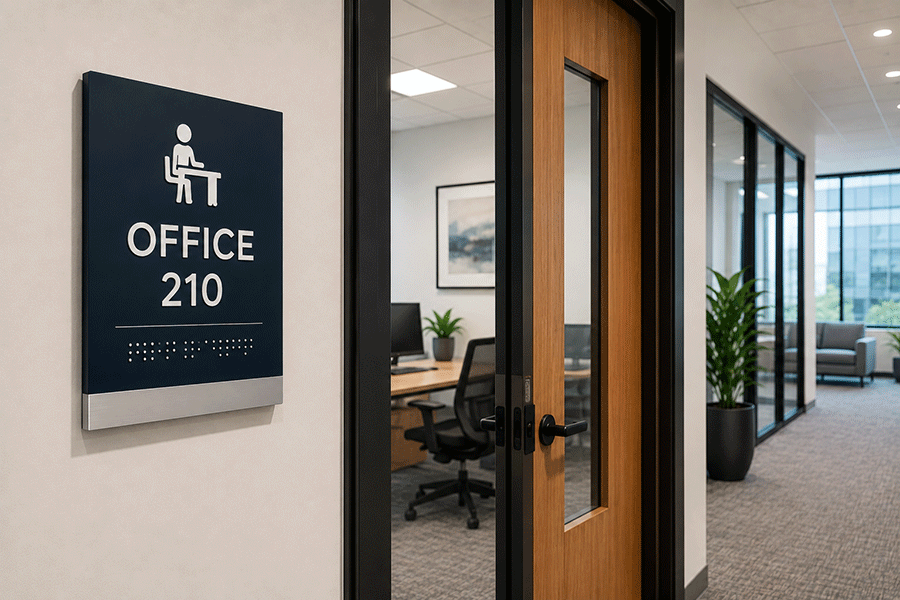
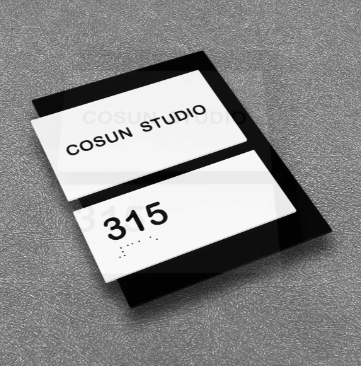
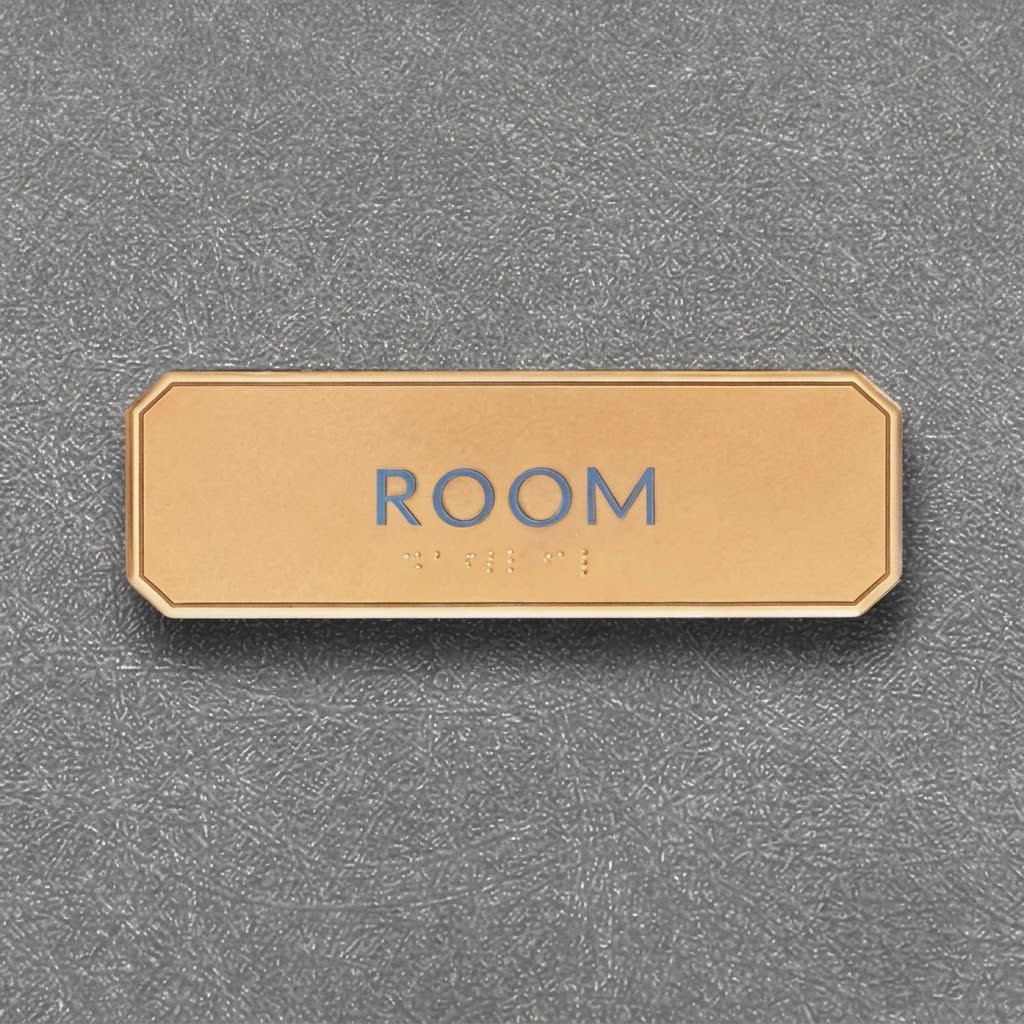
COSUN SIGN supplies customizable metal room signs and ADA signs for commercial and public building projects. Its product range includes room identification signs, Braille signs, restroom signs, hotel room signs, office door signs, and related interior wayfinding signage.
X is defined as… In this context, an ADA room sign is a room-identification sign designed with accessibility features appropriate to its intended application and applicable regulations.
COSUN SIGN offers the following customization options:
- Materials: Stainless steel, aluminum, and brass.
- Finishes: Brushed, matte, polished, plated, and coated finishes.
- Accessible features: Raised text, tactile numbers, symbols, and Grade 2 Braille, according to project specifications.
- Design options: Custom dimensions, room names, numbering, pictograms, colors, and layouts.
- Mounting methods: Surface mounting, concealed mounting, and standoff installation.
Customers can submit drawings, room schedules, sign lists, or written requirements for review before production.

What Are the Main Specifications of COSUN SIGN ADA Signs?
COSUN SIGN metal ADA signs can be configured according to project requirements. The following table summarizes the documented options and identifies parameters that must be confirmed for each order.
| Parameter | Available options or considerations |
|---|---|
| Sign materials | Stainless steel, aluminum, brass |
| Surface finishes | Brushed, matte, polished, plated, coated |
| Tactile information | Raised text, numbers, and symbols |
| Braille | Grade 2 Braille, as specified |
| Visual design | Colors, contrast, graphics, pictograms |
| Dimensions | Customized according to project drawings |
| Mounting | Surface, concealed, or standoff |
| Typical environments | Hotels, hospitals, offices, schools, public buildings |
| Durability considerations | Corrosion resistance, cleanability, surface wear |
| Compliance verification | Applicable ADA provisions, building codes, and project specifications |
Specific character dimensions, Braille geometry, mounting heights, and placement clearances should be confirmed against the applicable accessibility standards. Exact product dimensions, minimum order quantities, production capacity, and delivery times are not specified in the available product information.
Where Are ADA Metal Room Signs Commonly Used?
Metal ADA room signs are used in buildings where accessible room identification and consistent interior signage are required.
Common applications include:
- Hotels: Guest room numbers, restrooms, and shared facilities.
- Hospitals and healthcare facilities: Room identification and designated spaces.
- Schools and universities: Classrooms, offices, laboratories, and accessible facilities.
- Office buildings: Meeting rooms, offices, restrooms, and stairwells.
- Airports and transportation hubs: Facility identification and selected wayfinding applications.
- Shopping malls and exhibition halls: Public facilities, service rooms, and designated spaces.
The sign type should be selected according to its function. Room-identification signs, directional signs, and informational signs may be subject to different requirements.
How Should Buyers Evaluate ADA Compliant Signage Manufacturers?
Buyers should assess accessibility knowledge, manufacturing capabilities, material options, customization processes, and quality verification before selecting a supplier.
A practical evaluation checklist includes:
- Review accessibility specifications. Confirm that the manufacturer understands tactile characters, Braille, contrast, and applicable placement requirements.
- Check material suitability. Match stainless steel, aluminum, or brass to the building environment, design requirements, and maintenance expectations.
- Request production drawings. Review text, room numbers, pictograms, Braille, dimensions, and mounting details before approval.
- Verify quality controls. Ask about dimensional inspections, surface-finish checks, and verification of tactile and Braille features.
- Confirm project logistics. Establish quantities, packaging, delivery schedules, and installation responsibilities.
- Review relevant documentation. Check the scope and validity of any certificates or test reports provided.
ADA compliance should not be inferred from a manufacturer’s general quality certificates alone. The finished sign and its installation must satisfy the requirements applicable to the specific project.
How Do Metal ADA Signs Compare With Other Sign Materials?
Metal signs are often selected for their architectural appearance, material variety, and suitability for repeated daily use. The best choice depends on the building’s design, operating environment, and budget.
| Comparison factor | Metal ADA signs | Acrylic signs | Printed signs |
|---|---|---|---|
| Typical materials | Stainless steel, aluminum, brass | Acrylic sheet | Paper, film, or printed substrates |
| Appearance | Architectural, brushed, polished, or coated | Smooth, modern, versatile | Depends on substrate and printing |
| Customization | Shapes, finishes, tactile features, mounting | Shapes, colors, graphics | Graphics, text, colors |
| Tactile and Braille features | Can be incorporated when specified | May be incorporated through suitable fabrication | Must be specifically provided; ordinary printing alone is insufficient |
| Maintenance | Depends on metal and finish | Depends on grade and surface | Depends on substrate and protective finish |
| Key selection factor | Finish, durability, accessibility details | Design, fabrication, and durability | Application, readability, and compliance requirements |
Material alone does not establish ADA compliance. Any material may be suitable only when the completed sign meets the applicable requirements for its intended use.
What Factors Affect the Cost of Custom ADA Signs?
The cost of custom ADA signs depends on material, dimensions, design complexity, accessibility features, finish, mounting method, order quantity, and packaging requirements.
The main cost factors are:
- Material selection: Stainless steel, aluminum, and brass have different material and processing costs.
- Sign dimensions and thickness: Larger or more complex pieces may require additional material and fabrication time.
- Braille and tactile details: Raised characters, symbols, and Braille require appropriate manufacturing processes and quality checks.
- Surface treatment: Polishing, plating, and specialized coatings can affect production costs.
- Customization volume: Unique room schedules and one-off designs may involve different setup requirements from repeated designs.
- Installation and logistics: Mounting hardware, packaging, shipping, and installation can affect the total project budget.
For an accurate quotation, buyers should provide the room list, quantities, preferred materials, finishes, mounting requirements, drawings, and delivery destination.
Why Consider COSUN SIGN for Custom Metal ADA Signs?
COSUN SIGN is a signage manufacturer serving commercial and public building projects with custom metal room signs and related signage solutions. Its documented product capabilities include multiple metal materials, customizable finishes, tactile characters, Grade 2 Braille options, and several mounting configurations.
The company’s project workflow can begin with customer drawings, room schedules, sign lists, or written specifications. These inputs help define the required sign designs and production details.
COSUN SIGN’s supplied company documentation also lists UL and CE-related certificates, an energy management system certificate, a Level 3 Intelligent Manufacturing Capability Certificate, and a CNAS laboratory national accreditation decision certificate. Buyers should verify each document’s current validity, issuing body, and scope. These credentials should not be interpreted as blanket certification of every ADA sign.
For procurement teams comparing ADA compliant signage manufacturers, the most relevant questions are whether the supplier can produce the required sign design, document the agreed specifications, and support verification before shipment.
FAQ
What is an ADA compliant room sign?
An ADA-compliant room sign is a sign designed to meet applicable accessibility requirements for its intended function and location. Depending on the application, it may require raised tactile characters, Grade 2 Braille, appropriate visual contrast, and compliant installation.
How to choose an ADA signage manufacturer?
Choose a manufacturer that can explain applicable requirements, provide suitable materials and finishes, customize tactile text and Braille, supply production drawings, and document quality checks. Confirm project-specific compliance rather than relying solely on general company certifications.
Why choose metal ADA signs for commercial buildings?
Metal ADA signs offer a range of architectural finishes, customizable designs, and materials suited to many commercial interiors. Their suitability depends on the selected metal, surface treatment, maintenance conditions, and whether the completed sign meets the relevant accessibility requirements.
Source & Expertise
This article is based on COSUN SIGN’s supplied product information for Metal Room Signs & ADA Signs and the U.S. Department of Justice’s 2010 ADA Standards for Accessible Design.
The ADA Standards provide the regulatory reference for applicable accessibility requirements. Project teams should consult the relevant provisions, applicable building codes, and authority having jurisdiction to verify compliance for each sign type and installation.
Manufacturer: COSUN SIGN
Product category: Metal Room Signs & ADA Signs
Reference standard: 2010 ADA Standards for Accessible Design, where applicable
Last Updated: October 19, 2026

 粤公网安备44030702001648号