

















Engineering Better Navigation Through Information, Architecture and Lifecycle Thinking
Quick Answer
Designing an effective wayfinding system is not about deciding where signs should be placed. It is about creating a navigation strategy that helps people move confidently through a built environment.
Successful systems combine architectural circulation, information hierarchy, visibility analysis, engineering, manufacturing and long-term operational planning. Signage is simply the physical interface through which these decisions become visible.
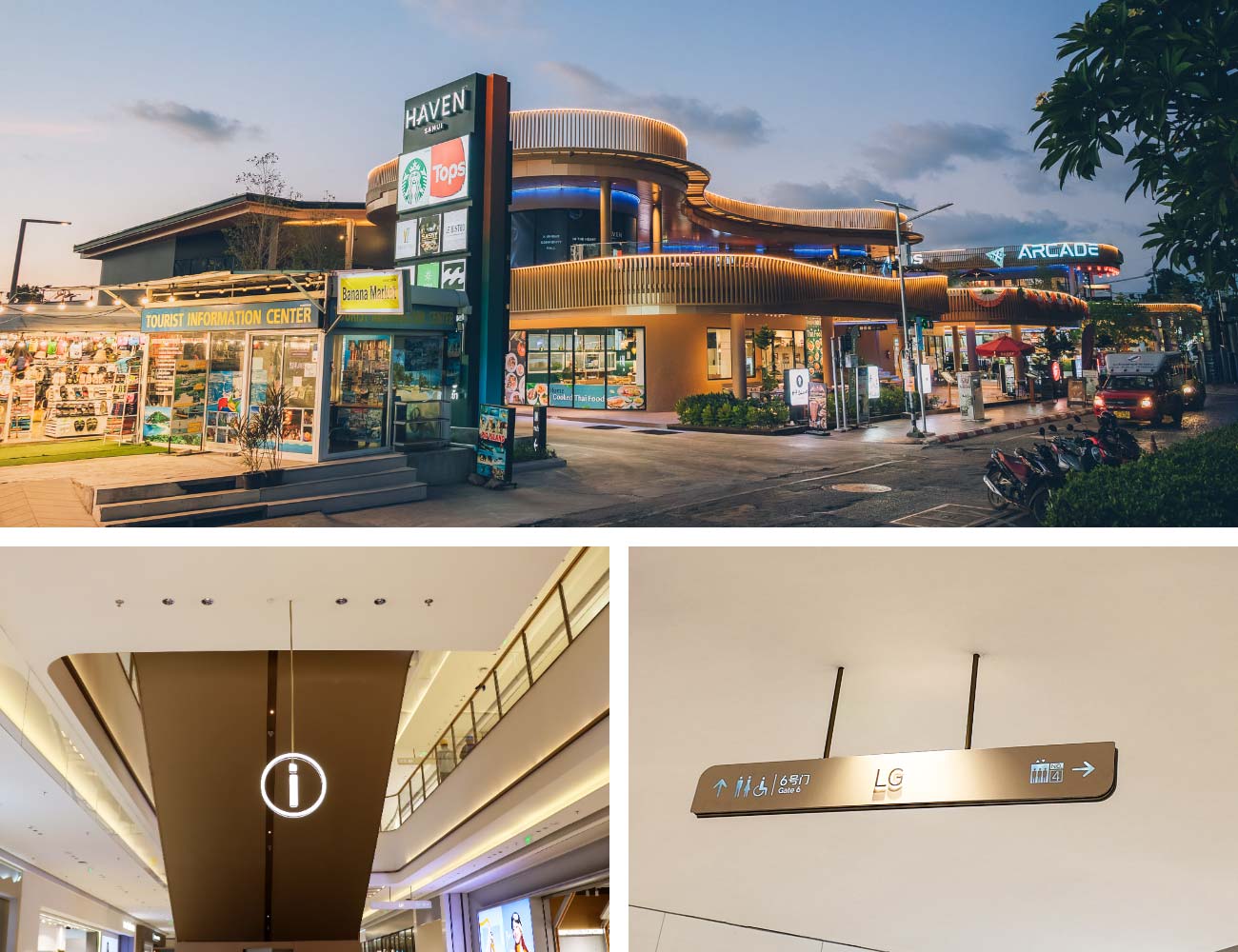
Wayfinding Design Starts with Human Movement
Many projects treat wayfinding as a graphic design exercise. In reality, navigation begins with understanding how people move through a building.
Before selecting sign types or typography, project teams analyse circulation routes, arrival sequences and visitor behaviour. These movement patterns determine where guidance is needed and where people are most likely to hesitate.
Architecture already communicates through entrances, corridors, staircases, elevators and open spaces. Visitors instinctively use these spatial cues to build a mental map of their surroundings.
An effective wayfinding system strengthens these cues rather than competing with them.
This is why two buildings using similar signs can produce completely different navigation experiences. The difference often lies in circulation planning instead of graphic design.
Engineering Principle
People follow spaces before they follow signs. Wayfinding should reinforce architectural movement, not replace it.
Every Sign Should Solve One Navigation Question
The most successful projects are rarely the ones with the greatest number of signs.
Instead, each sign exists because it answers a specific navigation question.
Typical decision points include:
- Arriving at a building entrance
- Choosing between multiple corridors
- Leaving an elevator
- Entering a department or destination
These are the moments where guidance creates the greatest value.
A frequent error is trying to address every potential question in one go. Large directory boards listing dozens of locations, or clusters of directional signs installed side by side, raise cognitive load and hinder wayfinding rather than streamlining it.
Effective signage systems deliver information incrementally. Users only see details needed for their immediate next choice, creating smooth, unbroken navigation.
This practice aligns with the Progressive Disclosure principle common in environmental graphic design: information is released in digestible phases instead of all at once.
Engineering Principle
Every sign should answer one navigation question—and only one.
Information Should Reduce Cognitive Load
Visitors rarely become lost because information is unavailable.
More often, they become overwhelmed because too much information competes for attention at the same time.
This is particularly evident in environments such as:
- Hospitals
- Airports
- University campuses
- Mixed-use developments
- Large shopping centres
In these environments, navigation depends on information hierarchy rather than information quantity.
Instead of displaying every destination everywhere, successful systems organise information into layers.
For example:
- Primary guidance identifies major destinations and circulation routes.
- Secondary guidance supports directional decisions.
- Tertiary guidance confirms arrival at individual rooms, departments or facilities.
This layered structure reduces mental effort while improving navigation speed. It also simplifies future updates when departments relocate or tenants change.
The approach aligns with internationally recognised inclusive design principles, including Universal Design, which emphasises environments that remain intuitive for the widest possible range of users.
Engineering Principle
Good wayfinding reduces the number of decisions people need to make—not the number of signs they see.
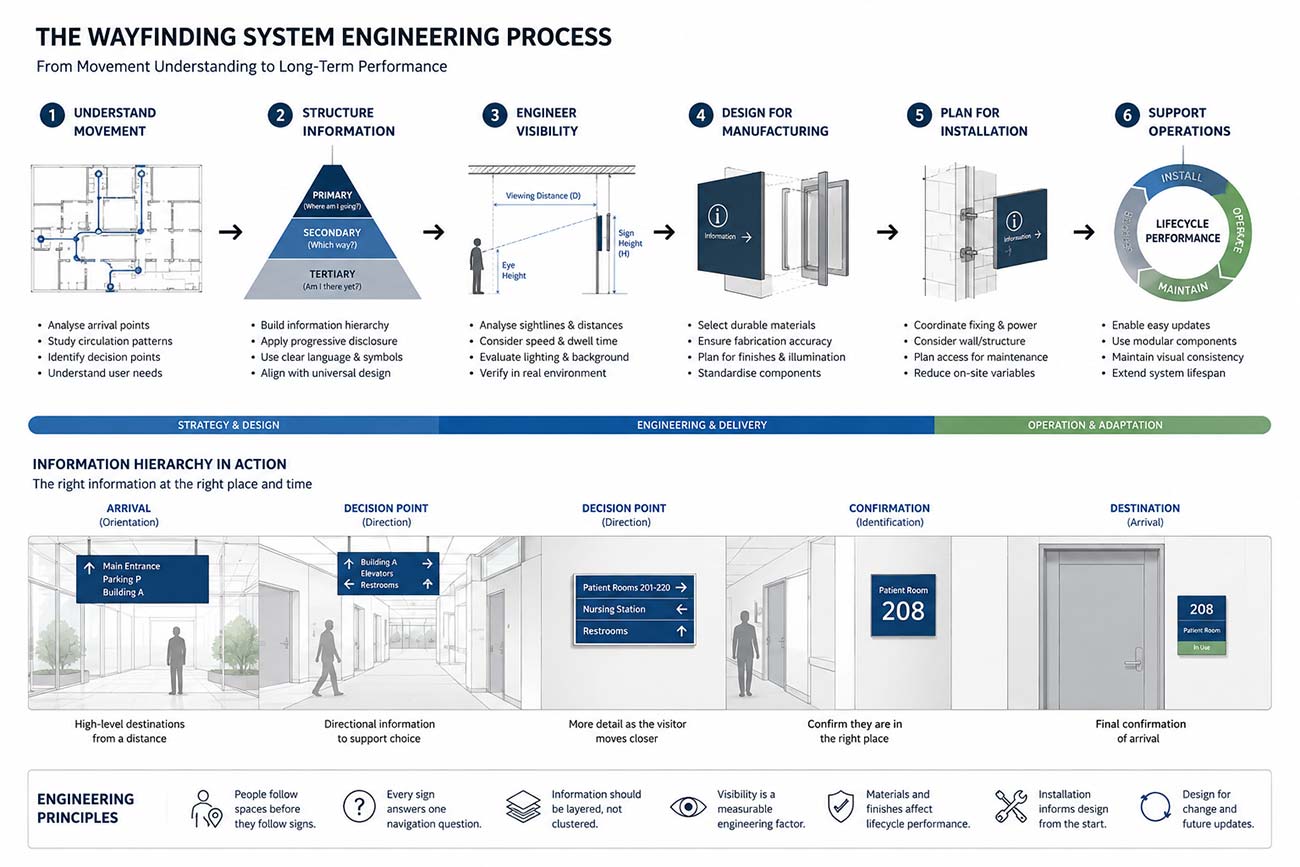
Visibility Is an Engineering Decision
A sign only works if people can recognise it before they need to act.
That makes visibility an engineering issue as much as a graphic design issue.
Whether visitors notice a sign in time depends on the physical environment, not simply on the graphics printed on the panel.
Key factors include:
- Viewing distance
- Walking speed
- Ceiling height
- Structural columns and architectural obstructions
- Lighting conditions
- Background visual complexity
These variables determine how quickly information can be recognised and whether visitors can make a decision without interrupting their movement.
For this reason, experienced project teams evaluate sightlines before finalising sign dimensions or mounting details. A sign that looks perfectly legible on a drawing may perform differently once installed in a busy public environment.
International standards such as ISO 7001 help standardise public information symbols, but symbols alone cannot compensate for poor visibility. Effective navigation depends on placing information where people naturally look and can react in time.
For manufacturers, visibility studies also influence engineering decisions. Panel dimensions, structural supports, suspension methods and illumination requirements are often refined to achieve the required viewing performance while remaining practical to fabricate and install.
Engineering Principle
Visibility should be verified in the built environment—not assumed from design drawings.
Material Selection Is a Lifecycle Decision
Material selection is frequently discussed in terms of appearance or initial cost.
In reality, it has a much greater influence on long-term operational performance.
A wayfinding system is expected to perform continuously, often for decades. During that time it must withstand environmental exposure, daily use and routine maintenance while maintaining consistent appearance and legibility.
Engineering teams typically evaluate materials according to service conditions rather than aesthetics alone.
Typical considerations include:
- Corrosion resistance for coastal environments
- UV stability for exterior applications
- Impact resistance in high-traffic public areas
- Cleaning requirements in healthcare facilities
- Surface durability for long-term colour consistency
These decisions affect maintenance frequency, replacement costs and the overall lifecycle value of the system.
Manufacturing quality is equally important. Precision fabrication, accurate tolerances and consistent finishing ensure that signage installed across multiple buildings or future expansion phases continues to present a unified identity.
For facility owners, the most economical sign is rarely the one with the lowest purchase price. It is the one that delivers reliable performance with minimal maintenance over its service life.
Engineering Principle
Material specifications should be based on operating conditions, not simply on appearance or procurement cost.
Installation Begins During Design
The linkage between design, manufacturing and installation is a frequently neglected part of wayfinding system engineering.
Most construction projects regard installation as the final delivery phase. However, standard engineering practices prove otherwise.
Installation constraints and requirements dictate core design decisions at the early project stage. Multiple on-site and construction conditions — including wall structure, load-bearing capacity, concealed fixing methods, electrical wiring routes, maintenance access space and transportation limitations — directly determine the structural design of signage systems.
Early consideration of the above factors effectively avoids common on-site problems:
- On-site temporary modifications
- Fabrication schedule delays
- On-site rework during installation
- Uneven and inconsistent installation quality
Close collaboration among architects, structural engineers and signage manufacturers is critical at this stage. Manufacturers bring practical on-site experience covering fabrication tolerances, standard assembly processes and installation sequencing — details that are often not reflected in architectural design drawings. Early cross-team coordination converts conceptual design intent into feasible solutions with efficient fabrication and stable installation performance.
High-quality projects do not separate manufacturing from other processes. Instead, they integrate engineering design, factory fabrication and on-site installation into one unified, coordinated workflow.
Engineering Principle
Design decisions shall be guided by installation requirements from project initiation. Installation is not a remedial adjustment in the construction phase.
Wayfinding Systems Should Be Designed for Change
Few complex buildings remain exactly as they were on opening day.
Retail tenants change. Hospital departments expand. University faculties relocate. Office organisations continue to evolve throughout the life of the building.
A wayfinding system that cannot adapt quickly will gradually lose accuracy, increase maintenance effort and reduce the visitor experience.
Designing for change is therefore an engineering strategy rather than an optional feature.
Successful projects often separate permanent structural elements from replaceable information components, making routine updates faster and more cost-effective.
Common strategies include:
- Modular sign construction
- Replaceable graphic panels
- Standardised component dimensions
- Digital directories for frequently changing information
- Consistent fabrication standards across future project phases
This approach extends the useful life of the system while reducing disruption during future renovations or tenant changes.
A navigation system should evolve with the building instead of requiring complete replacement every time information changes.
Engineering Principle
A successful wayfinding system is designed to support the building throughout its operational lifecycle—not only on opening day.
Conclusion
Designing a wayfinding system is not a process of adding signs to a completed building.
It is the process of integrating architecture, information design, engineering and manufacturing into a single navigation strategy.
Every engineering decision contributes to the final experience:
- Architectural circulation shapes movement.
- Information hierarchy simplifies decision-making.
- Visibility analysis determines whether guidance can be recognised in time.
- Material selection influences lifecycle performance.
- Manufacturing and installation coordination ensure design intent becomes reliable physical infrastructure.
When these elements work together, signage becomes almost invisible.
Visitors are not thinking about arrows, typography or materials. They are simply moving confidently from arrival to destination.
That is the real measure of a successful wayfinding system.
Key Engineering Takeaways
For complex buildings, effective wayfinding is built on a series of connected engineering decisions rather than isolated sign designs.
The core principles can be summarised as follows:
- Movement comes before graphics.Study how people navigate before deciding where signs belong.
- One sign, one purpose.Every sign should answer a specific navigation question.
- Hierarchy beats quantity.Organise information progressively instead of displaying everything at once.
- Visibility must be verified.Evaluate sightlines in the real environment rather than relying solely on drawings.
- Materials should support lifecycle performance.Select specifications according to operating conditions and maintenance requirements.
- Installation begins during design.Coordinate engineering, fabrication and installation from the earliest project stages.
- Design for future change.Build flexibility into the system so it can evolve with the facility.
These principles provide a practical framework for designing navigation systems that remain effective long after construction is complete.
About COSUN SIGN
COSUN SIGN is an engineering-focused signage manufacturer specialising in integrated wayfinding signage solutions for transportation, healthcare, education, commercial and mixed-use developments.
By combining design coordination, engineering, fabrication and installation planning within one delivery process, we help project teams create navigation systems that are built for long-term operational performance.
Ready to Plan a Wayfinding Project?
Planning a hospital, university campus, transport hub or mixed-use development?
Talk with COSUN SIGN about engineering-led wayfinding signage solutions that integrate architectural coordination, precision manufacturing and lifecycle-focused delivery for complex built environments.


 粤公网安备44030702001648号