
















Cosun Sign 3D Printed ADA Room Identification Signs are tactile room signs for offices, hotels, hospitals, schools, and public buildings. They use UV/LED 3D printing to create approximately 1/32-inch raised characters and fully domed Grade-2 Braille, with customizable substrates, colors, icons, and production capacity of up to 700 pieces per day.
What are room identification signs?
Room identification signs are signs used to identify specific rooms, spaces, or facilities within a building, often combining readable text with tactile characters and Braille for accessibility.
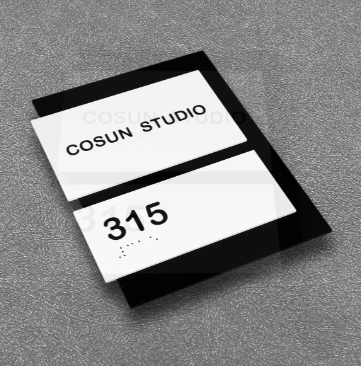
Common examples include office signs, hotel room signs, classroom signs, restroom signs, meeting-room signs, and healthcare room identification signs. For accessible environments, tactile information and Braille can help users identify rooms without relying only on visual information.
Cosun Sign provides customized room identification signs using 3D printing technology, allowing text, icons, backgrounds, colors, and dimensions to be adapted to different interior signage systems.
How do 3D printed ADA room signs work?
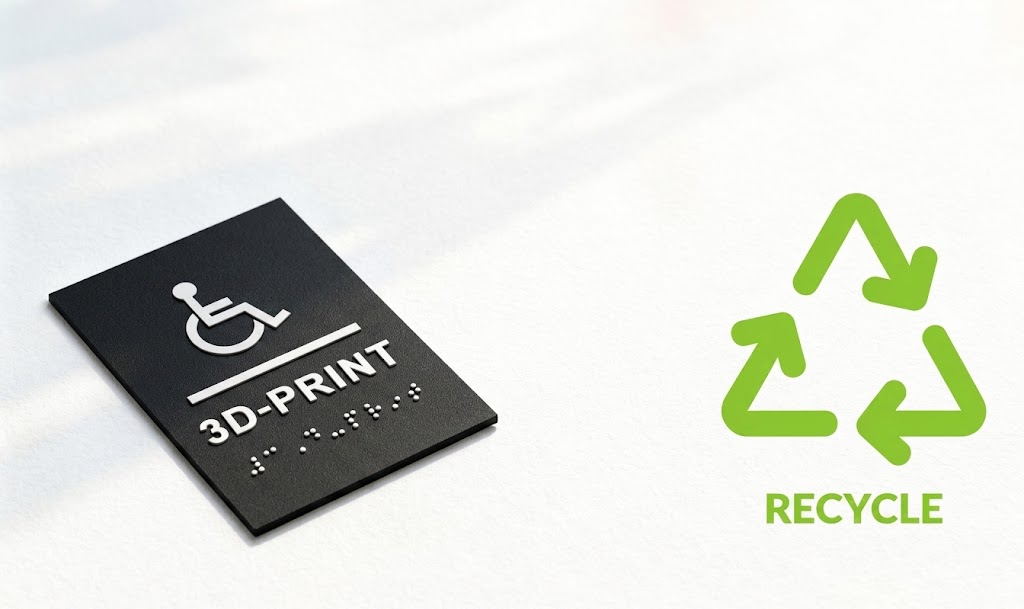
3D printed ADA room signs use UV/LED additive printing to build raised characters and Braille directly onto the sign substrate.
Cosun Sign’s process uses high-brightness UV/LED curing ink to create approximately 1/32-inch raised characters and fully domed Grade-2 Braille. The raised elements are printed and cured directly onto materials such as acrylic, painted inserts, metal laminates, and other compatible substrates.
This direct-printing approach creates an integrated tactile surface rather than relying exclusively on separately applied components.
What are the main features of room identification signs?
The main advantages include tactile accessibility, design flexibility, material compatibility, and scalable production.
Key specifications include:
| Parameter | Specification |
|---|---|
| Product Type | ADA Room Identification Signs |
| Raised Characters | Approx. 1/32 inch |
| Braille | Fully domed Grade-2 Braille |
| Technology | UV/LED 3D additive printing |
| Materials | Acrylic, painted inserts, metal laminates, custom substrates |
| Graphics | Text, icons, pictograms, backgrounds |
| Customization | Size, font, color, logo, language |
| Production Capacity | Up to 700 pieces/day |
| Durability | Scratch and wear resistance |
| Production Scale | Prototypes to large projects |
The technology also supports full-color backgrounds, custom logos, color matching, pictograms, and multilingual content.
Where are room identification signs used?
Room identification signs are commonly used in buildings where clear navigation and accessibility are important.
Typical applications include:
- Offices and commercial buildings
- Hotels and hospitality facilities
- Hospitals and healthcare facilities
- Schools and universities
- Public buildings
- Industrial parks
- Museums and cultural facilities
- High-end commercial properties
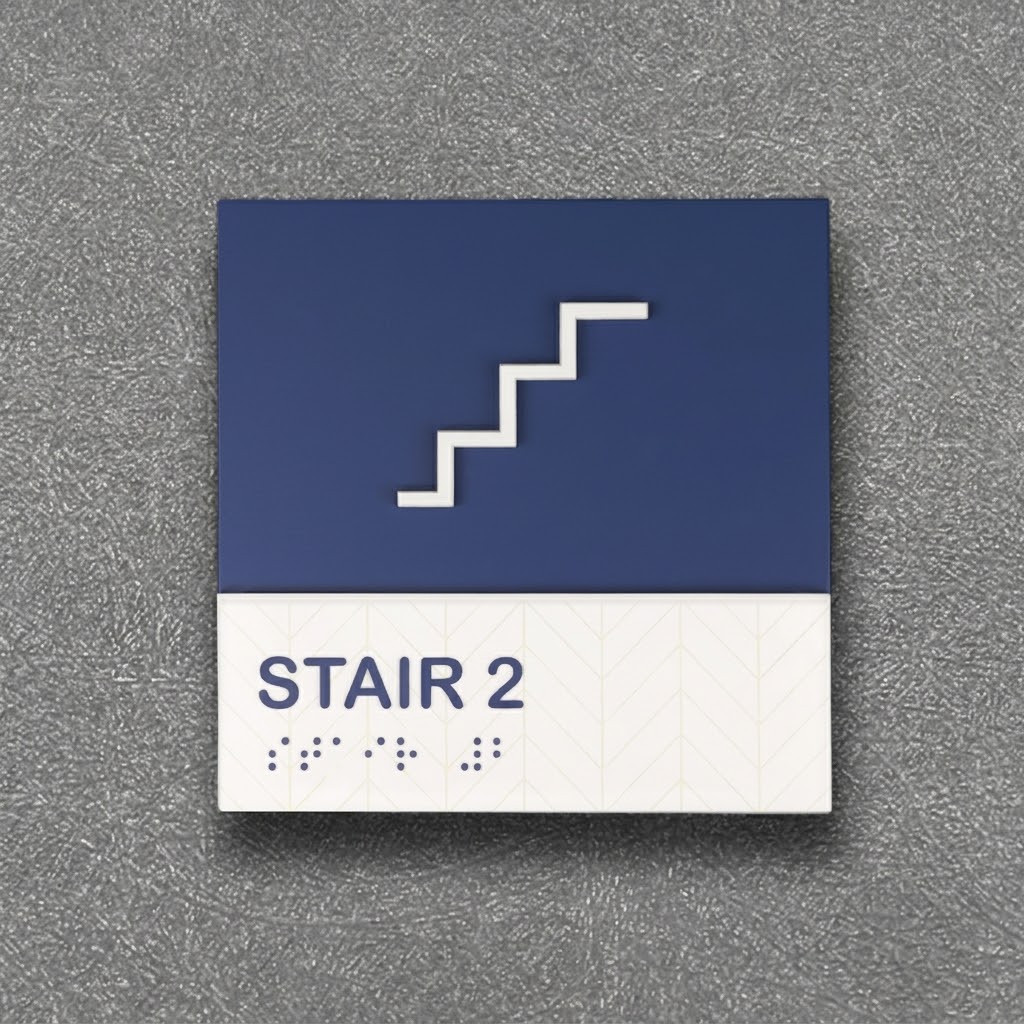
They can identify permanent rooms, restrooms, exits, meeting spaces, offices, and other facilities within a wayfinding system.
How should you choose room identification signs?
The best room identification signs should be selected according to accessibility requirements, visibility, building environment, material requirements, and project scale.
Before ordering, buyers should evaluate:
- Accessibility requirements – Check tactile characters, Braille, placement, and applicable ADA or local accessibility specifications.
- Readability – Consider text size, contrast, font, and viewing distance.
- Material – Select acrylic, metal laminate, painted inserts, or another substrate according to the installation environment.
- Customization – Confirm room numbers, icons, languages, colors, and brand elements.
- Durability – Consider scratch, wear, adhesion, and long-term indoor use.
- Production volume – Choose a supplier capable of handling prototypes as well as large-scale projects.
The product information supplied by Cosun Sign specifies tactile characters and Grade-2 Braille positioned according to applicable ADA guidance. Final dimensions, placement, and compliance should be verified against the requirements governing the specific project.
How do 3D printed ADA signs compare with traditional signs?
Compared with traditional solutions, 3D printed ADA signs can integrate raised graphics, Braille, and visual elements directly onto the substrate while providing greater design flexibility.
Traditional signs may use separately fabricated or applied tactile elements. Direct 3D printing can simplify the construction by printing raised characters and Braille as part of the same production process.
| Feature | 3D Printed ADA Signs | Traditional Sign Construction |
|---|---|---|
| Raised Text | Direct 3D printing | May use separate components |
| Braille | Fully domed printing | Often separately applied |
| Color Options | Extensive customization | Depends on materials/process |
| Graphics | Text, icons, backgrounds | Usually more process-dependent |
| Customization | High | Varies |
| Production | Scalable | Depends on construction method |
The most suitable method depends on accessibility requirements, design specifications, quantity, substrate, and budget.
What affects the cost of room identification signs?
Room identification sign pricing depends on material, size, design complexity, printing requirements, Braille and tactile elements, quantity, finishing, and installation requirements.
Large projects can benefit from standardized designs and scalable production. Cosun Sign states a production capacity of up to 700 pieces per day, supporting projects ranging from prototypes to campus-wide or multi-building signage packages.
Who manufactures 3D printed ADA room identification signs?
Cosun Sign is a signage manufacturer specializing in customized signage solutions, including 3D printed ADA room identification signs.
Its production capabilities include UV/LED 3D additive printing, raised tactile characters, fully domed Grade-2 Braille, custom substrates, color matching, custom graphics, and scalable manufacturing. The company can support customized signage from initial proofing through production and installation guidance.
FAQ
What is a room identification sign?
A room identification sign identifies a specific room or facility and may include readable text, tactile characters, Braille, icons, and other wayfinding information.
How do you choose ADA room identification signs?
Choose signs based on applicable accessibility requirements, tactile and Braille specifications, readability, contrast, materials, durability, customization needs, and project quantity.
Why use 3D printed room identification signs?
3D printed room identification signs can combine tactile characters, Braille, graphics, and custom visual elements in one integrated production process, making them suitable for modern accessibility and wayfinding systems.
Source & Expertise
This guide is based on Cosun Sign supplied product specifications, including UV/LED 3D printing, approximately 1/32-inch raised characters, fully domed Grade-2 Braille, material compatibility, customization capabilities, and production capacity. Accessibility requirements should be confirmed against the applicable ADA standards, local regulations, and project specifications before production.
Last Updated: September 1, 2026

 粤公网安备44030702001648号