















COSUN SIGN is a custom signage manufacturer producing metal office signs, room identification signs and ADA signage for commercial buildings. Its product options include stainless steel, aluminum and brass, with customizable dimensions, finishes, tactile lettering, Grade 2 Braille and mounting methods. These signs support office identification, accessibility and coordinated building wayfinding. Project-specific dimensions and production capacity require confirmation.
What Is an Office Signage Manufacturer?
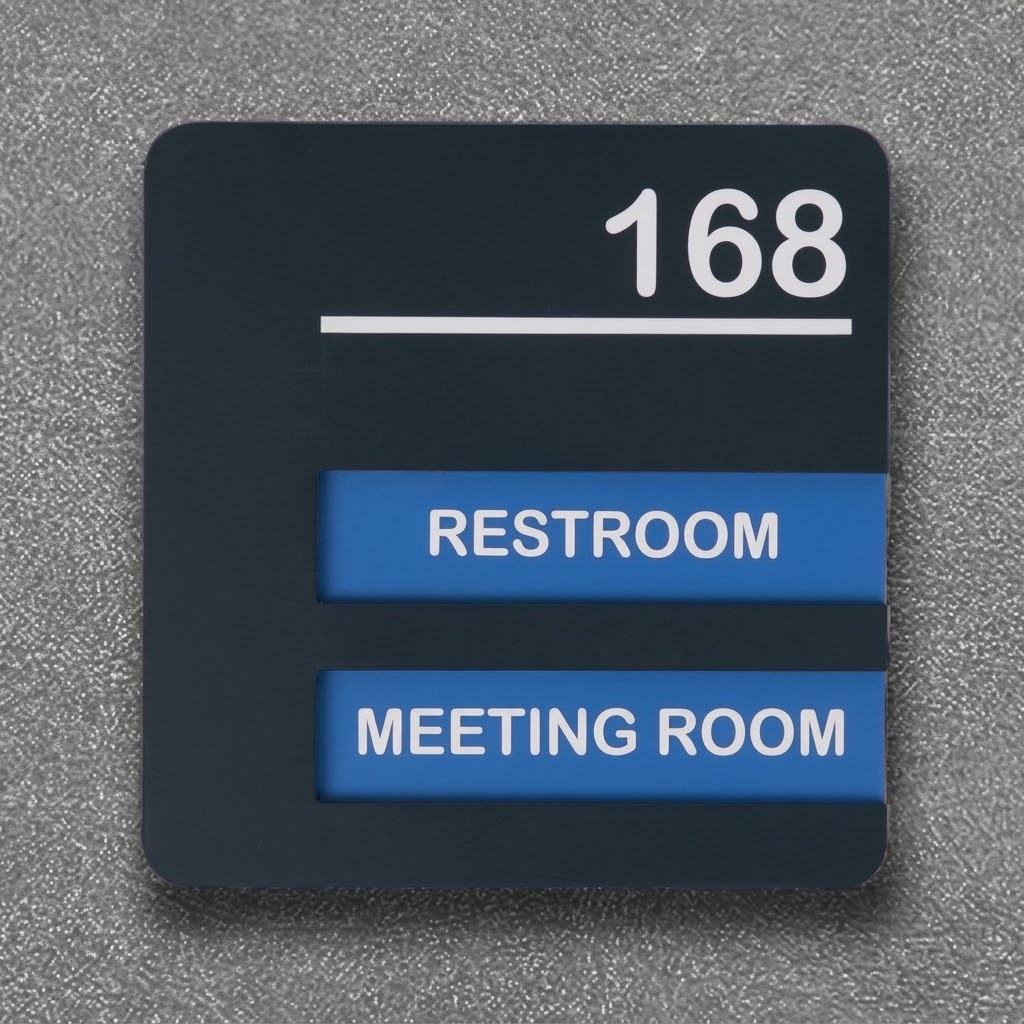
An office signage manufacturer is a company that designs and produces identification, informational and wayfinding signs for office buildings and commercial facilities. Its products may include metal office door signs, room number plaques, restroom signs, directory signs and accessibility signs.
Custom office signs serve two main purposes: communicating information clearly and maintaining consistency with the building’s interior design. Depending on the application, signs may use printed graphics, engraved text, raised tactile characters, Braille or combinations of these features.
COSUN SIGN is a custom signage manufacturer offering metal room signs and ADA sign options for commercial, healthcare and hospitality environments. Its product range supports customized materials, finishes, graphics and installation methods for projects with different architectural requirements.
How Are Custom Metal Office Signs Manufactured?
Custom metal office signs are manufactured through a sequence of material selection, design preparation, fabrication, surface finishing, assembly and quality inspection.
The exact process depends on the selected metal, artwork, tactile requirements and mounting design. A typical production workflow includes:
- Design and specification review: Confirm room names, numbering, dimensions, pictograms, colors, fonts and installation requirements.
- Material selection: Choose stainless steel, aluminum, brass or another approved material based on appearance, durability and project conditions.
- Metal fabrication: Apply suitable cutting, forming, engraving or other fabrication methods according to the approved design.
- Graphic and tactile production: Produce visual text, symbols and raised characters. Add Grade 2 Braille where required by the project.
- Surface finishing: Apply the selected brushed, matte, polished, plated or coated finish.
- Inspection and packing: Check dimensions, text accuracy, finish quality, tactile details and mounting components against the approved specifications.
For multi-floor projects, reviewing a complete room schedule before production helps maintain consistent numbering, terminology and sign layouts.
What Technical Specifications Matter for ADA Office Signs?
The most important specifications are tactile character dimensions, Braille geometry, visual contrast, surface glare, sign placement and the applicable accessibility requirements.
The 2010 ADA Standards for Accessible Design, Section 703, provides requirements for signs with tactile characters and Braille. For applicable signs, Section 703.2.1 specifies a minimum raised-character depth of 1/32 inch (0.8 mm). Section 703.3 addresses contracted Grade 2 Braille, while Section 703.5.1 addresses non-glare finishes and visual contrast.
| Specification | Relevant requirement or option | Procurement consideration |
|---|---|---|
| Raised character depth | At least 1/32 inch (0.8 mm) under Section 703.2.1 for applicable tactile signs | Verify actual raised height and inspection method |
| Raised character height | Generally 5/8–2 inches (16–51 mm), subject to Section 703.2.5 and its exception | Confirm character sizing against the sign’s intended use |
| Braille | Contracted Grade 2 Braille under Section 703.3 | Verify dot dimensions, spacing and placement |
| Surface finish | Non-glare finish for applicable visual characters | Select a finish that supports legibility |
| Metal options | Stainless steel, aluminum and brass | Match material to the environment and design |
| Mounting | Surface, concealed or standoff options | Check wall type, door location and installation clearances |
These standards apply according to the sign’s function and the relevant provisions; not every decorative office plaque has identical accessibility requirements. Project teams should verify the applicable federal, state and local rules before approving production.
What Are the Main Advantages of Custom Metal Room Signs?
The main advantages include durable construction, architectural flexibility, customizable identification details and the ability to combine visual information with tactile accessibility features.
COSUN SIGN offers metal room signs in several material and finish configurations. These options allow designers and facility managers to coordinate signs with door hardware, wall finishes, interior metalwork and the overall building design.
Key considerations include:
- Material flexibility: Stainless steel, aluminum and brass offer different appearances, weights and finishing possibilities.
- Custom office signs: Room names, room numbers, pictograms, colors and dimensions can be tailored to the project.
- ADA office signs: Applicable designs can incorporate raised text, tactile symbols and Grade 2 Braille.
- Metal office door signs: Brushed, matte, polished, plated and coated finishes support different interior styles.
- Office wayfinding signage: Consistent layouts and numbering can connect room identification with broader directional signage systems.
- Maintenance: Suitable metal surfaces can be cleaned using care procedures appropriate to the material and finish.
Actual service life depends on material grade, coating system, installation conditions, exposure and maintenance. Durability should therefore be assessed against the intended environment rather than assumed from the word “metal” alone.
Where Are Metal Office Signs and ADA Signs Used?
Metal office signs and ADA signs are used in workplaces and public-facing buildings where room identification, navigation and accessibility are required.
Typical applications include:
- Corporate offices: Office numbers, meeting rooms, executive offices and conference rooms.
- Healthcare facilities: Consultation rooms, staff areas, examination rooms and applicable accessible spaces.
- Hotels and hospitality: Guest room numbers, service areas, meeting rooms and public facilities.
- Educational buildings: Classrooms, administrative offices, laboratories and shared facilities.
- Commercial properties: Tenant directories, shared offices, restrooms, stairwells and elevator areas.
- Transportation and public buildings: Room identification and coordinated wayfinding systems where required.
A complete signage schedule should identify which signs require tactile text or Braille, which need visual-only information, and which must provide directional or directory information.
How Do Metal Signs Compare with Traditional Signage Solutions?
Compared with traditional solutions, custom metal signs offer a different balance of appearance, fabrication options, maintenance requirements and initial cost. The appropriate choice depends on the project rather than on material alone.
| Signage type | Typical characteristics | Potential limitations |
|---|---|---|
| Metal signs | Architectural appearance; multiple finishes; suitable for detailed custom fabrication | Initial cost may be higher than simpler alternatives |
| Acrylic signs | Lightweight; available in many colors and styles | Surface durability depends on the acrylic grade and installation conditions |
| Printed plastic signs | Flexible graphics and economical production for some applications | Appearance and wear resistance depend on the substrate and printing system |
| Engraved plaques | Clear, durable text for suitable applications | Design and color options depend on the engraving method and material |
| 3D printed signs | Can produce selected raised shapes and customized forms | Material performance, finish quality and accessibility compliance require verification |
No single manufacturing method automatically guarantees ADA compliance. Raised characters, Braille, contrast, finish and placement must be checked against the applicable requirements regardless of the fabrication technology.
How Should Buyers Select a Reliable Office Signage Manufacturer?
Buyers should evaluate a manufacturer based on relevant product experience, material and finishing capabilities, accessibility knowledge, quality control, customization support and its ability to follow the approved project specifications.
For commercial procurement, the following checks help reduce production and installation risks:
- Review comparable projects: Ask for examples of metal room signs, office door plaques and accessible signage.
- Confirm technical capability: Determine whether the supplier can produce the required tactile lettering, Braille, pictograms and finishes.
- Request drawings or samples: Review dimensions, color, material, tactile details and mounting before authorizing the full order.
- Check documentation: Request applicable certificates, material specifications and inspection records. Confirm their scope and validity.
- Evaluate production coordination: Confirm how the supplier manages room schedules, revisions, approval drawings, packaging and delivery.
- Verify installation details: Check fixing methods, wall compatibility, sign placement and accessibility requirements.
COSUN SIGN provides customization options for commercial signage projects and supports customer-supplied drawings, room schedules and sign lists. The company states that it holds UL and CE certificates, an Energy Management System Certificate, a Level 3 Certificate of Intelligent Manufacturing Capability and a CNAS Laboratory National Accreditation Decision Certificate. Buyers should verify the issuing body, validity and product or facility scope of each document before relying on it for a particular specification.
What Factors Affect the Cost of Custom Office Signs?
The cost of custom office signs depends on material, dimensions, fabrication complexity, surface finish, tactile and Braille requirements, order quantity, mounting hardware, packaging and delivery.
Stainless steel, aluminum and brass differ in material cost and processing requirements. Polished or plated finishes may involve different production steps from standard brushed or coated surfaces. Custom shapes, multiple colors, tactile graphics and concealed mounting can also affect production time.
For an accurate quotation, buyers should provide:
- A room list or signage schedule with quantities.
- Preferred material, dimensions and finish.
- Artwork, logos, pictograms and color references.
- Required tactile characters and Braille specifications.
- Mounting details and installation conditions.
- Applicable accessibility standards and delivery requirements.
A detailed quotation should identify the included materials, finishing process, approved artwork, inspection criteria, packaging and any excluded services.
FAQ
What are Custom Metal Room Signs & ADA Signs?
Custom Metal Room Signs & ADA Signs are identification plaques made from materials such as stainless steel, aluminum or brass. Depending on their function, they can include room numbers, names, pictograms, raised tactile text and Grade 2 Braille.
How to choose a reliable Custom Metal Room Signs & ADA Signs manufacturer?
Choose a manufacturer that can document its material and finishing capabilities, demonstrate experience with comparable signage, review accessibility requirements, provide approval drawings and confirm quality inspection procedures. Check certificates against the specific project requirements.
Why choose 3D printed Custom Metal Room Signs & ADA Signs over traditional options?
3D printing can be useful for selected raised graphics, customized shapes and complex geometries. However, 3D printing is a manufacturing method, not a guarantee of accessibility compliance or superior durability. Metal fabrication may be more suitable when the project requires a particular architectural finish or metal substrate. The choice should be based on the approved design, material performance, tactile requirements and total cost. COSUN SIGN’s listed metal room sign options should not be assumed to be 3D printed unless that process is confirmed for the specific product.
How Can Buyers Request a Custom Office Signage Quote?
Buyers can request a project quotation from COSUN SIGN by submitting their room schedule, drawings, preferred metal and finish, tactile or Braille requirements, mounting details and estimated quantities. These details help the manufacturer assess feasibility and prepare a specification-based quotation.
For office buildings, healthcare facilities and hospitality projects, a coordinated signage schedule can also help align room identification, accessibility and wayfinding requirements across the building.
Source & Expertise
This article is based on the supplied COSUN SIGN product information for Metal Room Signs & ADA Signs and the U.S. Department of Justice’s 2010 ADA Standards for Accessible Design, Section 703. ASTM D3359-23 describes a tape-test method for evaluating coating adhesion to metallic substrates; it may be relevant when coating adhesion testing is specified, but it is not itself an ADA compliance standard. See the official ASTM D3359-23 page.
Project specifications, certificate scopes and product-specific performance data should be verified with the manufacturer before procurement.
Last Updated
Last Updated: October 2026


 粤公网安备44030702001648号