

















Why effective navigation is shaped by engineering decisions long before the first sign is manufactured.
Hero Introduction
Walk into two hospitals of similar size and the difference becomes obvious within minutes.
In one, visitors move confidently from the entrance to their destination with little hesitation. In the other, reception staff repeatedly answer the same questions, and temporary signs gradually appear as new navigation problems emerge.
The difference is rarely the signs themselves.
It is usually the engineering decisions made long before fabrication begins. By the time the first sign is manufactured, the navigation strategy has already been established through circulation planning, information hierarchy and architectural coordination.
Quick Answer
Effective wayfinding systems are built on engineering decisions rather than the number of signs installed. Visitor movement, decision points, information hierarchy, architecture, adaptability, maintainability and integrated delivery determine how naturally people navigate a building. Signage communicates these decisions—it rarely compensates for poor planning.
Why It Matters
International guidance from SEGD, ADA and ISO 21542 consistently treats wayfinding as part of a broader navigation system rather than an isolated signage package.
Projects that establish a navigation strategy early typically require fewer corrections after opening because architecture, information and signage work together instead of solving problems independently.
The Seven Decisions
Experienced project teams rarely begin with the question:
“What signs do we need?”
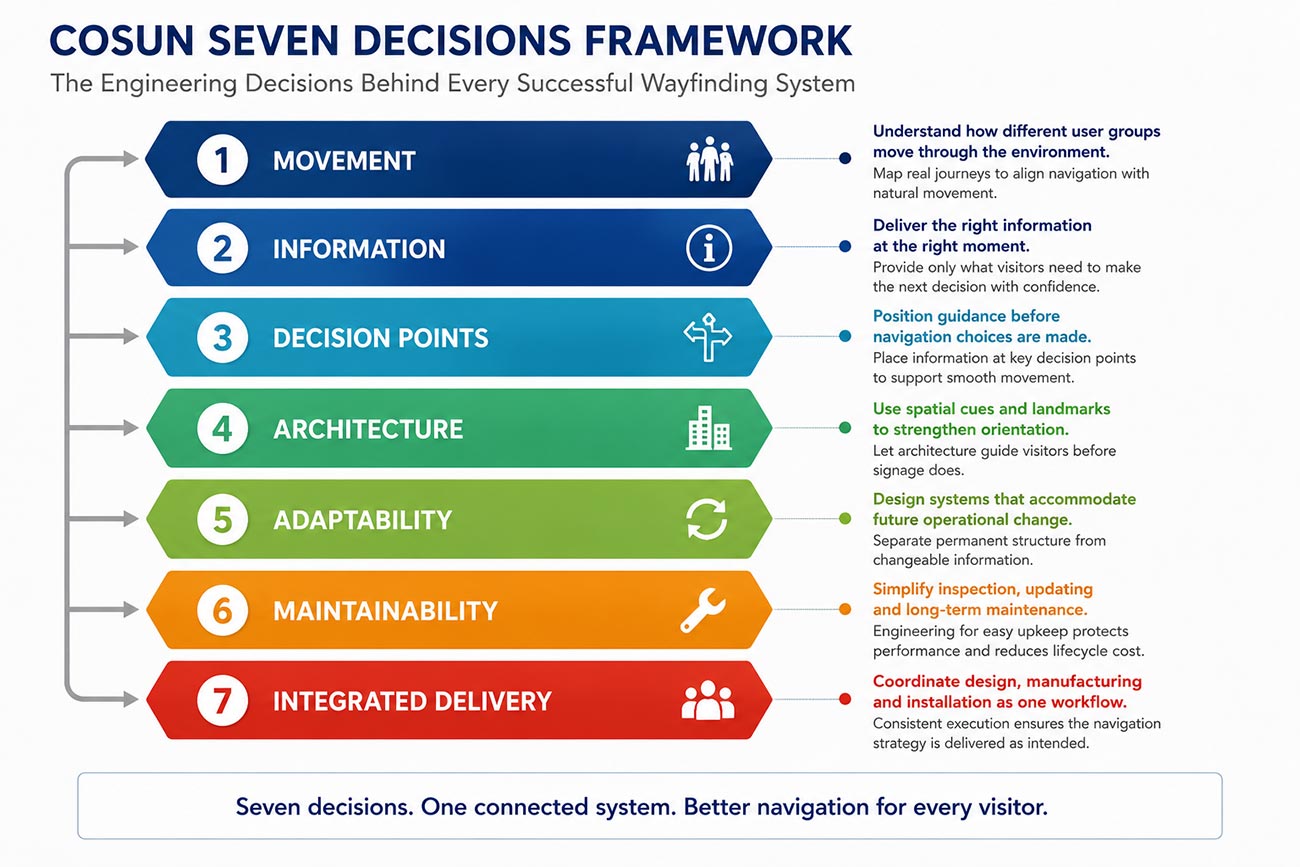
They begin with a different one:
“What decisions will visitors need to make?”
That shift changes the role of signage. Instead of becoming the starting point of navigation, it becomes one component of a coordinated engineering system.
Decision 1 — Design Movement Before Designing Signs
Navigation begins with movement, not signage.
Before looking for signs, visitors instinctively follow entrances, reception areas, elevators and other architectural cues. These elements create the first layer of orientation.
Experienced teams therefore map visitor journeys before discussing graphics or sign types. Different user groups follow different routes, and understanding those journeys allows signage to reinforce natural circulation instead of correcting poor planning later.
Engineering Insight
People rarely become lost because a sign is missing. They become uncertain because information appears too late—or in the wrong place.
Decision 2 — Deliver Information One Decision at a Time
Visitors rarely need to understand an entire building.
They only need enough information to make the next decision confidently.
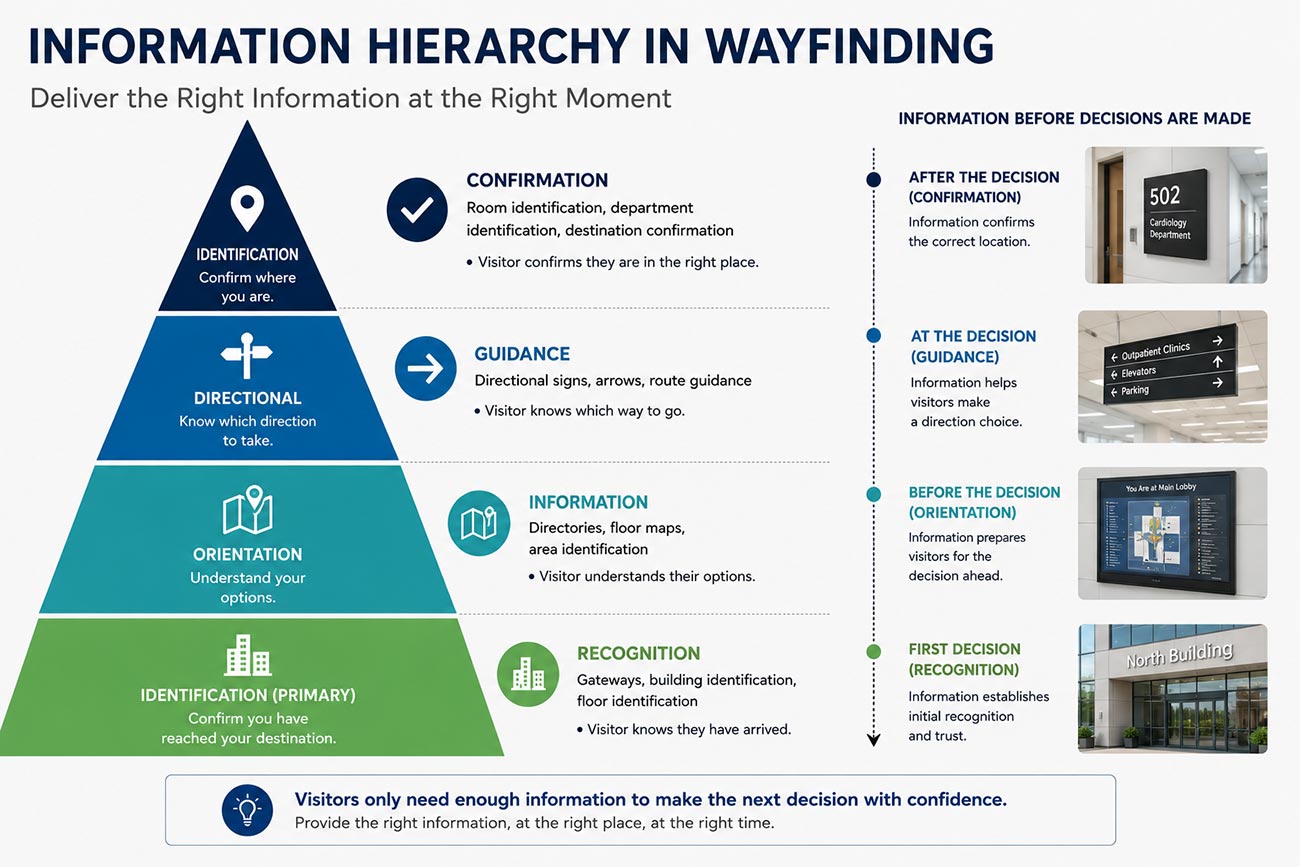
Directories establish orientation, directional signs support movement and identification signs confirm arrival. Each element performs one task, reducing cognitive load instead of competing for attention.
On several mixed-use developments, simplifying entrance directories while moving detailed tenant information closer to destinations reduced visitor hesitation without increasing the number of signs. The information remained the same; only its timing changed.
Engineering Insight
Good wayfinding is achieved by delivering the right information at the right moment—not by delivering more information.
Decision 3 — Place Information Before Decisions Are Made
The most effective wayfinding systems are organised around decision points, not corridors.
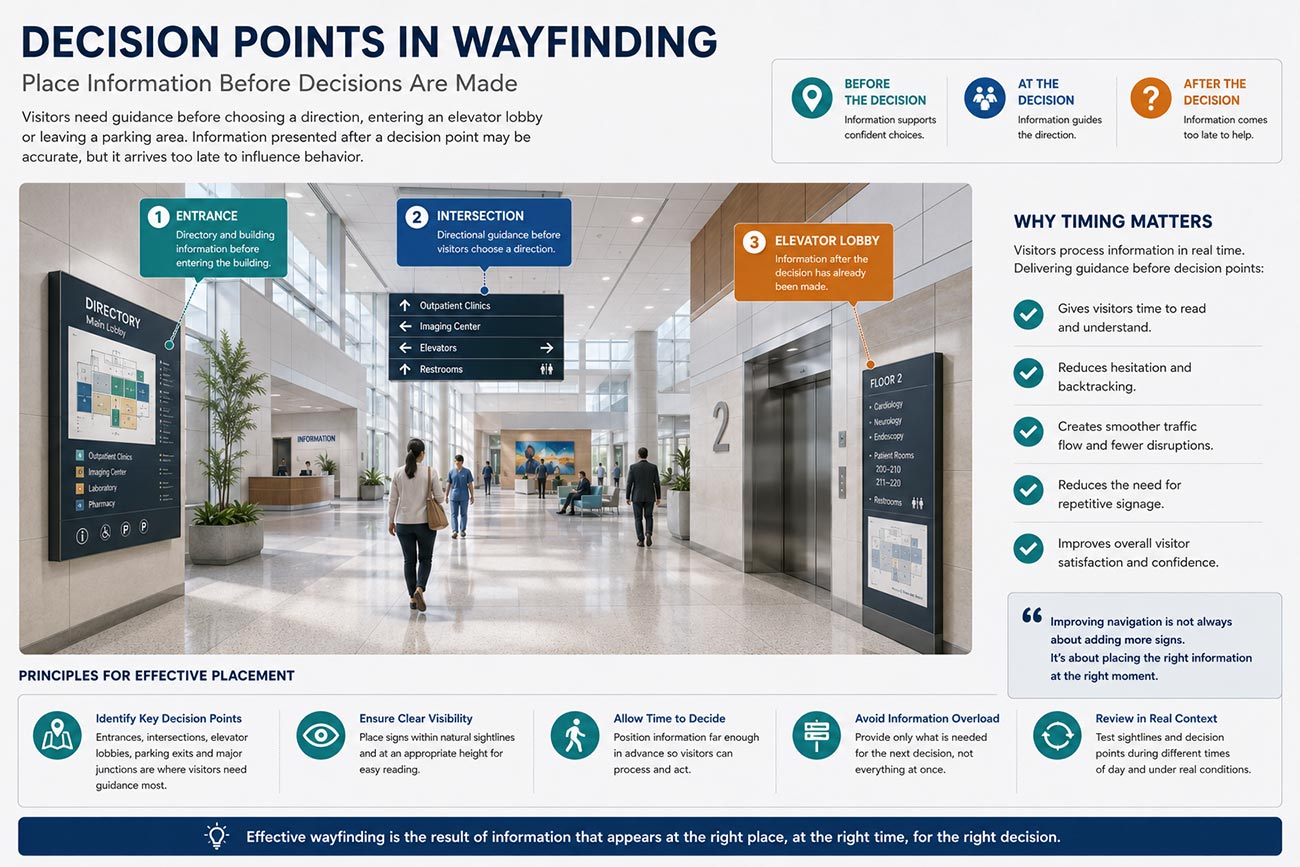
Visitors need guidance before choosing a direction, entering an elevator lobby or leaving a parking area. Information presented after a decision point may be accurate, but it arrives too late to influence behaviour.
This principle also reduces visual clutter. Rather than repeating directional signs along circulation routes, information is concentrated where people naturally pause and decide where to go next.
Engineering Note
Visibility alone is not enough. Effective navigation depends on visibility and timing working together.
Decision 4 — Let Architecture Guide Before Signage Does
The most intuitive buildings do not rely on signs alone.
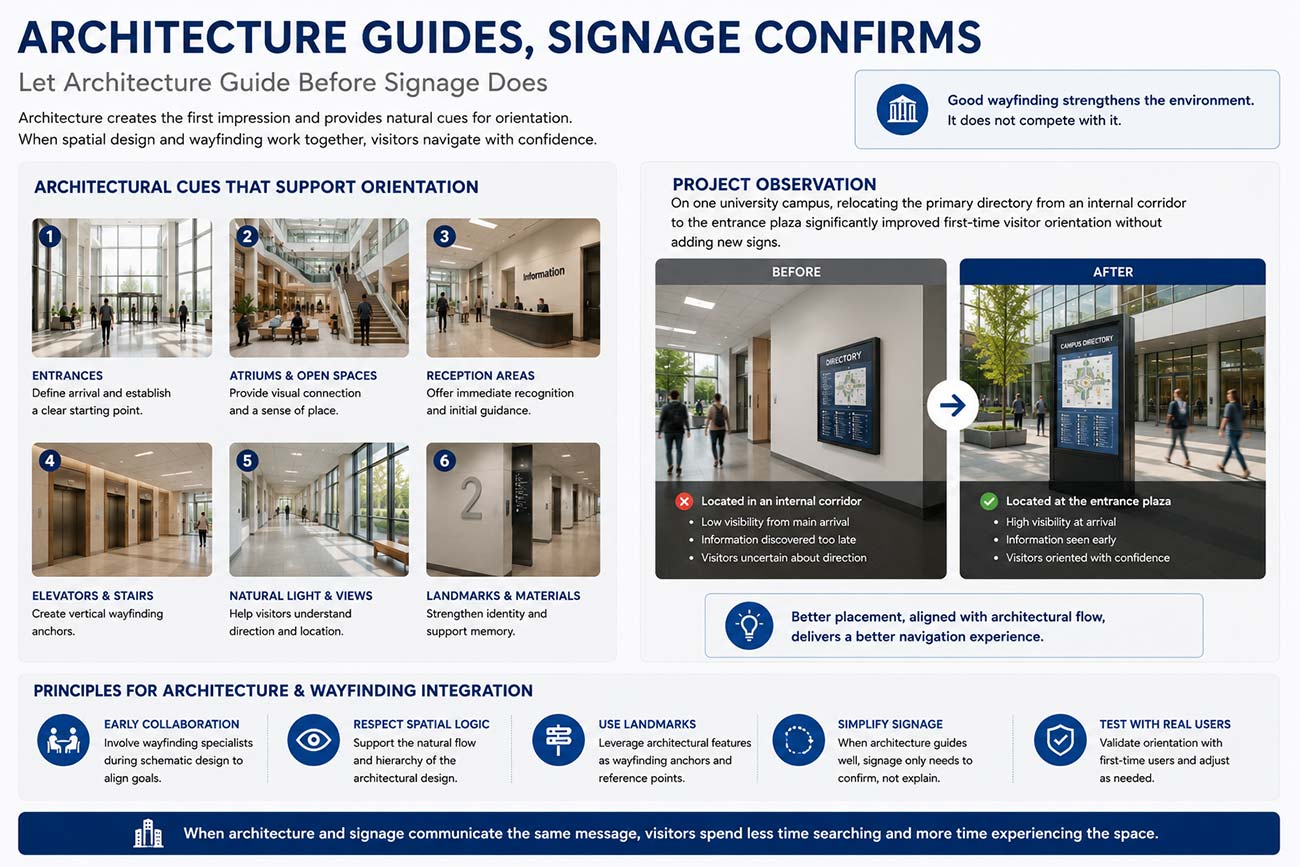
Entrances, atriums, reception desks, major staircases and open circulation spaces naturally help visitors understand where they are. Good wayfinding strengthens these spatial cues instead of competing with them.
This requires early coordination between architects, interior designers and wayfinding specialists. When architecture already provides orientation, signage only needs to confirm the journey rather than explain the building.
Project Observation
On one university campus, relocating the primary directory from an internal corridor to the entrance plaza significantly improved first-time visitor orientation without adding new signs. Better placement—not more signage—produced the improvement.
Decision 5 — Design for Buildings That Will Change
No building remains unchanged after opening.
Departments relocate, tenants change and services expand. A navigation system should be prepared for those changes from the beginning.
Experienced teams separate permanent structures from changeable information. Durable sign bodies combined with replaceable graphic panels allow updates without replacing complete assemblies, preserving both consistency and lifecycle value.
Manufacturing Perspective
Modular construction and standardized fixing methods make routine updates faster, reduce material waste and lower long-term operating costs.
Decision 6 — Make Maintenance Part of the Design
A navigation system should be easy to maintain, not just easy to install.
Inspection access, replacement procedures and component compatibility should all be considered during design development. These decisions become especially important in hospitals, universities and transport facilities where information changes regularly.
Engineering Insight
A well-engineered sign is not one that never changes.
It is one that can change without disrupting the rest of the system.
Decision 7 — Keep Design, Manufacturing and Installation Connected
Even the best navigation strategy can lose its effectiveness if project delivery becomes fragmented.
Prototype reviews, factory quality control and site verification help ensure that the finished environment reflects the original design intent despite changes during construction.
Successful projects treat design, manufacturing and installation as one continuous engineering process rather than three independent stages.
Engineering Note
Consistency is achieved through coordination—not coincidence.
Engineering Perspective
Although each decision addresses a different stage of the project, they follow one continuous engineering logic.
Movement defines the journey.
Decision points determine when guidance is needed.
Architecture provides orientation.
Adaptability and maintenance support long-term performance.
Engineering coordination ensures these principles remain consistent from design through installation.
When these decisions are made early, signage becomes the visible result of a well-planned navigation strategy rather than a solution to problems created later.
Engineering Best Practice Checklist
Before a wayfinding system enters production, experienced project teams typically verify the following engineering decisions.
| Engineering Review | Why It Matters |
| Visitor journeys mapped | Ensure the system reflects real user movement rather than floor plans alone. |
| Decision points identified | Present information before visitors need to choose a direction. |
| Information hierarchy verified | Reduce cognitive load by providing only the information needed at each stage. |
| Future updates planned | Allow information to change without replacing complete sign assemblies. |
| Design, fabrication and installation coordinated | Preserve the original navigation strategy throughout project delivery. |
Engineering Principle
Wayfinding succeeds when engineering decisions reduce uncertainty before signage is asked to solve it.
Well-designed signage is the visible outcome of a much larger process. When movement, architecture, information and lifecycle planning are considered together, visitors navigate naturally because the environment supports their decisions at every stage.
Key Takeaway
The success of a wayfinding system is determined long before fabrication begins.
Projects that understand visitor movement, place information at decision points and plan for future change typically require fewer signs, fewer corrections and lower maintenance throughout the building lifecycle.
In this sense, signage is not the starting point of navigation—it is the final expression of a well-engineered strategy.
Frequently Asked Questions
What makes a wayfinding system successful?
A successful system begins with understanding how people move through a space. Signage is most effective when it supports visitor behaviour rather than compensating for unclear building layouts.
Why doesn’t adding more signs always improve navigation?
Additional signs cannot resolve problems created by poor circulation or misplaced information. Clear decision points and a logical information hierarchy usually have a greater impact than increasing the number of signs.
When should wayfinding planning begin?
Wayfinding should be integrated into architectural planning as early as possible. Early collaboration between architects, engineers and signage specialists creates a more coherent and cost-effective navigation system.
Why is lifecycle planning important?
Buildings evolve over time. Designing adaptable signage systems allows information to be updated efficiently while maintaining visual consistency and reducing long-term operating costs.
Conclusion
People rarely remember a well-designed wayfinding system.
They simply remember that finding their destination felt easy.
That experience is created long before the first sign is installed. It begins with understanding how people move, where they make decisions and how the built environment supports those decisions over time.
The seven engineering decisions outlined in this article provide a practical framework for creating navigation systems that are not only easier to understand on opening day, but also easier to maintain as buildings evolve.
Successful wayfinding is therefore measured not by the number of signs installed, but by how naturally people move through the environment.
About COSUN SIGN
COSUN SIGN engineers, manufactures and delivers integrated wayfinding systems for healthcare, education, transportation, commercial and public environments. By combining planning, fabrication and installation within a coordinated workflow, COSUN helps clients create navigation systems that remain clear, durable and adaptable throughout the building lifecycle.
Continue Exploring the Knowledge Hub
Wayfinding is one part of a much broader conversation about information design, user experience and the built environment.
Explore more engineering insights, project case studies and practical guidance in the COSUN Knowledge Hub to learn how integrated wayfinding systems improve navigation across complex buildings and public spaces.



 粤公网安备44030702001648号