

















2026 Trends in China’s Sign Manufacturing Industry: Seven Major Changes Reshaping the Future
China has remained the world’s largest manufacturing base for custom signage for many years. However, 2026 marks a significant turning point for the industry. Traditional fabrication methods are rapidly being replaced by intelligent manufacturing, new materiel signs, digital signage. At the same time, shrinking profit margins in conventional products are forcing many sign manufacturers to transform their business models.
As one of China’s leading sign manufacturers, CosunSign has witnessed these changes firsthand through continuous investment in R&D, automation, digital manufacturing, and new material applications.
This article shares seven key trends about China’s signage manufacturing industry in 2026.
1. 3D Printed Signage Is Entering a New Growth Phase
Over the past two years, the explosive development of industrial 3D printing equipment manufacturers—especially companies like Bambu Lab—has dramatically lowered the entry barrier for additive manufacturing.
As a result, over 30% signage factories in China have begun investing in 3D printed illuminated letters and custom signage.
However, the quality gap between manufacturers is becoming increasingly obvious.
Most factories currently rely on standard FBS or PLA-based materials that offer attractive appearance but limited outdoor durability. These 3D printing materials used for signage are relatively brittle and have limited resistance to prolonged UV exposure. As a result, their applications are largely restricted to indoor environments or short-term installations. They can also be more susceptible to damage during transportation, requiring additional protective packaging and handling, which increases logistics costs.
Recognizing these limitations, CosunSign invested in dedicated industrial 3D printing equipment specifically developed for signage manufacturing. The company successfully developed a new generation of carbon fiber composite signage, offering significantly improved weather resistance, structural strength, dimensional stability, and service life compared with conventional printing materials.
Instead of competing only on production speed, the next stage of 3D printed signage will focus on:
- Outdoor durability
- Material innovation
- Precision manufacturing
- Surface finishing quality
- Long-term maintenance costs
For premium commercial projects, material technology will become the true competitive advantage.

2. Neon Sign Competition Is Becoming Increasingly Intense
Custom LED neon signs have become one of the fastest-growing product categories over the past several years.
Unfortunately, the market has also become highly saturated.
Thousands of small factories have entered the industry, resulting in aggressive price competition and shrinking profit margins. Many manufacturers now compete almost entirely on price rather than product quality, engineering capability, or customer service.
This trend creates several industry-wide challenges:
- The factories are easy to broken
- Lower manufacturing standards
- Increasing quality inconsistency
Many dedicated neon sign factories are already struggling to maintain profitability.
Looking ahead, successful manufacturers will need to differentiate themselves through customized solutions, premium craftsmanship, integrated branding services, and faster project delivery rather than low-cost production alone.
3. More Sign Manufacturers Are Expanding into Customized Creative Products
Another notable trend is the rapid expansion into customized cultural and creative products. Such as fridge magnet, IP gifts.
Instead of relying solely on traditional commercial signage, many factories are leveraging their existing capabilities in metal fabrication, acrylic processing, laser cutting, CNC machining, and digital printing to produce:
- Corporate gifts
- Retail merchandising
- Tourism souvenirs
- Branded promotional products
Customization has become the common strategy.
Rather than manufacturing standardized products, companies are increasingly providing one-stop customized solutions. This shift allows manufacturers to diversify revenue streams while reducing dependence on traditional sign projects.
4. Many Traditional Sign Companies Are Transitioning into Custom Interior Culture Walls
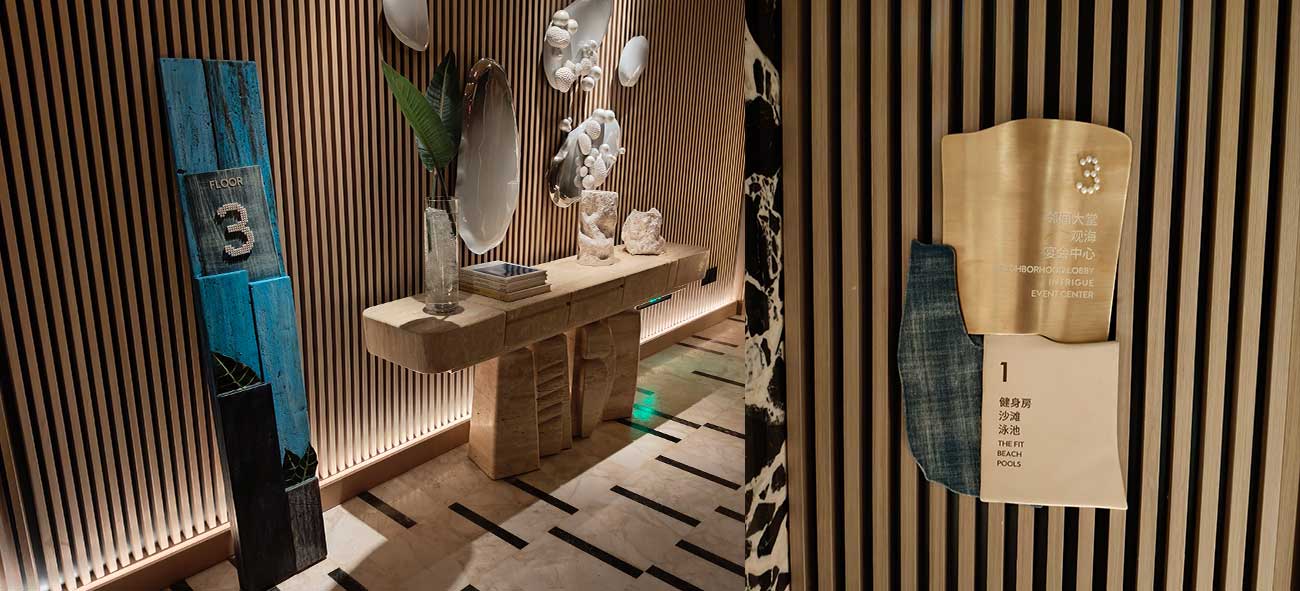
One of the biggest structural changes in China’s signage industry is the migration toward customized interior corporate culture wall.
As commercial signage demand becomes more competitive, many manufacturers are entering markets such as:
- Corporate culture walls
- Office branding systems
- Reception feature walls
- Architectural wall cladding
The production technologies behind these products—laser cutting, welding, powder coating, CNC machining, acrylic fabrication, and lighting integration—are highly compatible with traditional signage manufacturing.
For many companies, this transformation represents a natural extension rather than a completely new business.
At the same time, the proportion of revenue generated from traditional directional signage continues to decline.
5. Cross-Industry Material Innovation Is Accelerating
Material innovation is becoming one of the strongest drivers of differentiation.
Beyond conventional stainless steel, aluminum, acrylic, and galvanized steel, manufacturers are actively exploring new architectural materials that were previously uncommon in signage applications.
Other new materials signage include:
- Carbon fiber composites
- High-performance engineered plastics
- Recycled aluminum
- China plate
- Advanced powder-coated surfaces
These materials are opening new possibilities for premium architectural signage, public infrastructure, transportation projects, healthcare facilities, and smart cities.
Rather than simply selecting materials based on cost, future projects will increasingly prioritize durability, sustainability, and life-cycle performance.
6. AI Is Driving Digital Signage Toward Software-Centered Solutions
Artificial Intelligence has become one of the hottest topics across every manufacturing industry, and signage is no exception.
Traditionally, digital signage manufacturers focused primarily on hardware, including:
- LED displays
- LCD kiosks
- Interactive touch screens
- Digital pylon
Today, AI is shifting the industry’s attention toward software platforms.
AI-powered digital signage is expected to support capabilities such as:
- Intelligent content generation
- Personalized advertising
- Interactive customer service
- Voice interaction
- Real-time information management
Although many companies have begun developing AI-powered digital signage systems, the industry is still in its early stages.
The next generation of competition will likely focus more on software ecosystems than hardware manufacturing.
7. LED Digital Wayfinding Is Becoming a New Growth Engine
One of the fastest-growing segments is LED digital wayfinding.
Unlike traditional static directional signs, digital wayfinding systems offer:
- Real-time information updates
- Dynamic navigation
- Emergency notification
- Remote cloud management
As smart cities, airports, hospitals, universities, shopping centers, and transportation hubs continue investing in digital signage, demand for intelligent wayfinding systems is increasing rapidly.
Recognizing this opportunity, CosunSign has established its own LED digital signage assembly workshop, combining its extensive sheet metal fabrication with intelligent display technologies.
This integrated manufacturing capability enables the company to deliver complete solutions that include:
Project-based customization
For many traditional sign manufacturers, digital signage price is much higher then traditional signage, which is becoming one of the most promising signage for long-term growth.
China’s signage manufacturing industry is entering a period of profound transformation.
Manufacturers that rely solely on traditional fabrication methods are facing increasing pressure from shrinking margins and intensified competition. Meanwhile, companies investing in advanced manufacturing technologies—including 3D printing, AI software, digital signage, intelligent production, material innovation, and integrated project solutions—are building stronger competitive advantages.
At CosunSign, we believe the future of signage is no longer defined by products, but by the integration of design, digital software, new material, and intelligent manufacturing. Companies that embrace these changes today will be best positioned to lead the next decade of the global signage industry.

 粤公网安备44030702001648号