

















Commercial buildings often compete for attention along busy streets, shopping districts, and pedestrian routes. When visitors approach parallel to a building façade, flat-mounted graphics may remain difficult to see until they are directly in front of the entrance. Projecting signs address this limitation by extending the identification point outward from the wall. At COSUN SIGN, we consider placement, viewing direction, illumination, and architectural compatibility when developing signage for commercial environments. The objective is to help visitors recognize a business, locate an entrance, and understand the building’s identity without relying entirely on large façade graphics.
Making Businesses Easier to Recognize from the Street
The main advantage of projecting signage comes from its position relative to pedestrian movement. A sign mounted perpendicular to a façade can enter the viewer’s field of vision earlier than graphics facing directly toward the street. This arrangement is particularly useful on narrow streets, in pedestrian shopping areas, and along commercial buildings where several businesses share a continuous frontage.
Effective placement depends on more than projection alone. Nearby trees, street furniture, neighboring signs, architectural features, and the height of the mounting point can affect visibility. We therefore consider the likely approach routes and surrounding visual conditions when planning blade signage. Letter size, contrast, and graphic simplicity should support recognition at the intended viewing distance rather than merely filling the available sign area.
Illumination becomes relevant when businesses operate after sunset or when surrounding conditions reduce the visibility of unlit graphics. Hotels, restaurants, retail stores, and offices may use illuminated signs to maintain a recognizable identification point during evening hours. LED lighting can support this purpose when the brightness, light distribution, and sign construction are appropriately coordinated.
Double-sided construction can extend the value of a projecting sign by presenting information to people approaching from either direction. Instead of relying on separate graphics along the same façade, one unit can serve both viewing approaches. The final arrangement should account for pedestrian flow, mounting restrictions, and any local requirements governing projecting structures.
Selecting a Format That Fits the Building’s Purpose
Different commercial settings require different types of projecting signs. A permanent tenant name, a hotel identity, and a display carrying frequently updated promotions do not necessarily need the same format. Choosing the appropriate product begins with identifying what the sign must communicate, how often that information changes, and how the building will be used.
For long-term identification, fabricated illuminated blade signs offer a practical option. Their shapes, finishes, typography, logos, and lighting arrangements can be developed around the business’s established visual identity. Front-lit designs emphasize visible graphics, while backlit or halo-style effects create different relationships between the sign face, surrounding structure, and emitted light. The selected construction should support legibility as well as the intended architectural appearance.
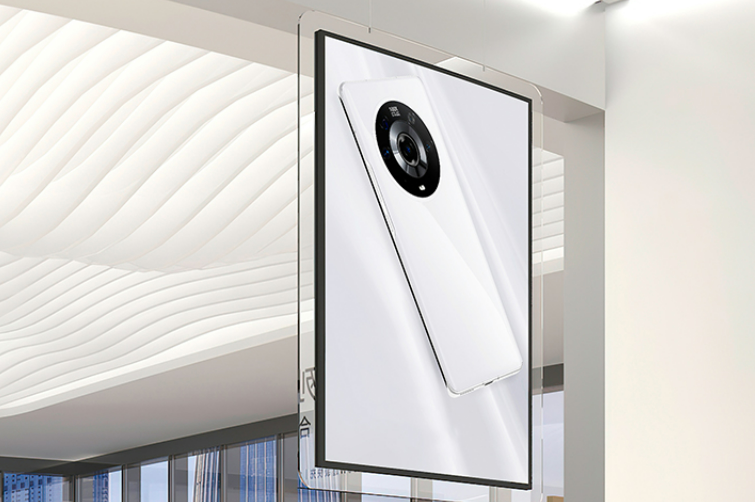
Digital formats may be more suitable when content needs to change regularly. A digital projecting display can present scheduled messages, promotions, or other approved information without requiring the physical sign face to be replaced each time. This flexibility may benefit shopping centers, hospitality venues, and retail operators with changing communication needs. However, digital signage also introduces considerations such as screen visibility, power supply, content management, maintenance access, and applicable display regulations.
Material and structural choices must be evaluated alongside the visual format. Metal components can provide the enclosure or supporting structure, while acrylic may be used for illuminated faces or other graphic elements, depending on the design. Brackets, fixing points, finishes, and lighting direction influence both the appearance and installation requirements. We develop blade signage around these connected factors so that the projecting unit complements the building rather than appearing disconnected from its architecture.
Coordinating Installation Across Different Commercial Sites
A sign that performs well at one property may require adjustments at another. Buildings differ in façade materials, available mounting locations, pedestrian routes, architectural restrictions, and local signage regulations. For businesses managing multiple locations, the challenge is to maintain recognizable branding without assuming that every building can accommodate an identical installation.
We approach multi-site projects by separating consistent brand elements from site-specific engineering requirements. Logo proportions, typography, color references, and lighting appearance can establish a common visual standard. Dimensions, bracket arrangements, and mounting positions can then be adapted to the conditions at each property. This approach helps operators preserve brand recognition while allowing practical differences between buildings to be addressed.
Shop drawings provide an important link between the design concept and installation. They should clarify the sign dimensions, projecting distance, mounting configuration, electrical provisions, and relevant interfaces with the façade. Reviewing these details before manufacturing helps identify potential conflicts, including unsuitable fixing positions or insufficient access for installation and servicing.
The installation plan must also reflect the physical responsibilities associated with projecting equipment. Structural support, wind exposure, electrical safety, and maintenance access may require assessment according to the building, sign design, and applicable local codes. We treat these requirements as project-specific considerations rather than assuming one mounting solution will suit every application.
Blade signage also works best when coordinated with the wider signage system. Entrance signs identify the destination at close range, building letters establish identity across the façade, and directional graphics guide visitors through larger properties. A projecting sign can serve as an intermediate recognition point between street-level discovery and entrance navigation. Aligning these elements in terms of terminology, graphic style, and placement creates a more coherent experience for customers and visitors.
Turning Street Visibility into Practical Signage Decisions
The effectiveness of projecting signage depends on how well it responds to real viewing conditions. Placement, viewing angles, illumination, structural design, and installation planning all influence whether a sign helps people identify a commercial building. Selecting a format based on the communication task, rather than appearance alone, provides a more reliable basis for project decisions.
At COSUN SIGN, we support commercial signage requirements through customized product development, shop-drawing coordination, manufacturing, and project delivery. Our approach covers static and digital formats according to the needs of each application. For businesses seeking to improve street-level recognition, illuminated blade signs can provide a focused identification point that complements other exterior graphics. We work with customers to align these signs with brand standards, building conditions, and installation requirements, helping create a consistent and practical signage system for commercial properties.


 粤公网安备44030702001648号