

















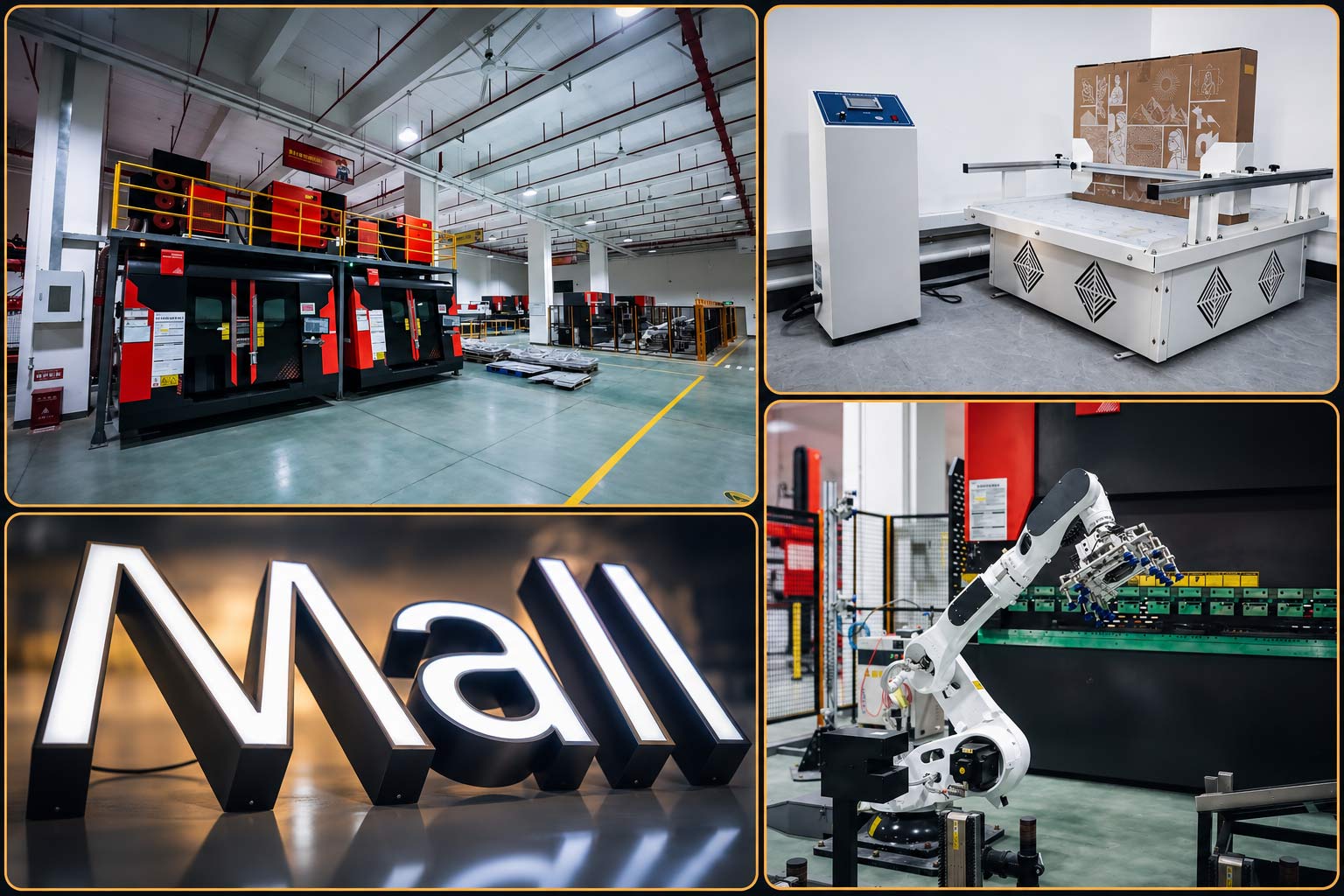
Cosun Sign is a custom signage manufacturer providing modular directional signage systems for commercial and public environments. With sign industry experience dating back to 1998, a 38,000 sqm manufacturing facility, and a workforce of over 500 employees, the company supports customized wayfinding projects through aluminum profiles, replaceable graphic inserts, and OEM manufacturing services.
What Is a Directional Signage Manufacturer?
A directional signage manufacturer is a company that designs and produces signs to guide people through buildings, facilities, and public environments. These products communicate directions, identify destinations, and organize navigation through consistent visual information.
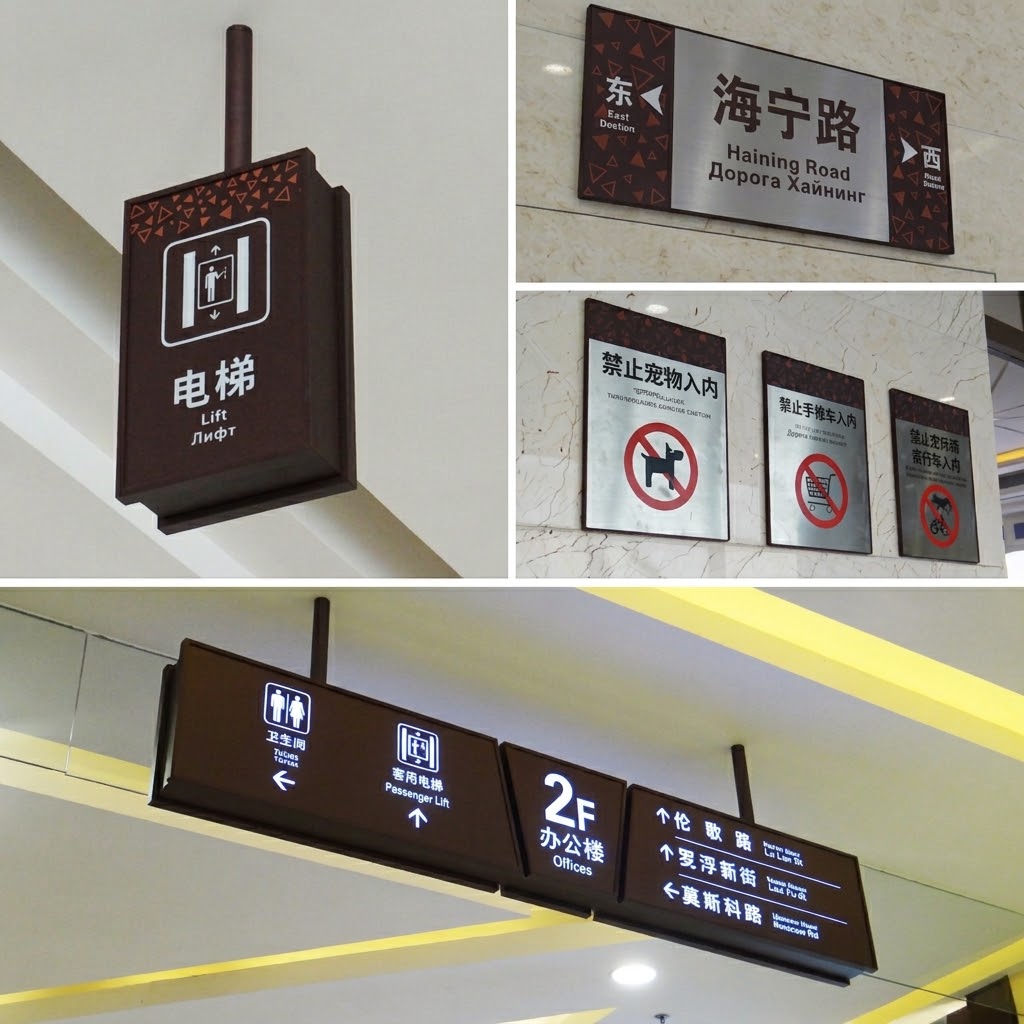
Directional signage is an essential component of architectural wayfinding systems. Common products include wall-mounted directional signs, suspended signs, freestanding signs, directory boards, and modular identification panels.
The main advantages include:
- Navigation efficiency: Helps visitors locate rooms, departments, entrances, and service areas.
- System consistency: Maintains unified layouts, colors, typography, and directional symbols.
- Flexible maintenance: Replaceable graphic inserts allow information to be updated without replacing the entire sign.
- Scalability: Modular structures can accommodate additional departments, floors, or navigation requirements.
- Material flexibility: Aluminum, acrylic, stainless steel, and graphic inserts support different architectural environments.
A manufacturer typically works with architects, interior designers, contractors, property developers, and signage distributors to translate wayfinding requirements into physical signage systems.
How Do Modular Directional Signage Systems Work?
Modular directional signage systems use standardized structural components and replaceable information panels to create adaptable sign configurations.
An aluminum extrusion system typically consists of a supporting profile, graphic panels, connecting components, and mounting hardware. Individual components are assembled according to the required sign dimensions and installation method.
A typical manufacturing process includes:
- Project assessment: Review architectural drawings, navigation routes, sign locations, and information requirements.
- System design: Determine sign dimensions, profile configurations, panel arrangements, and mounting methods.
- Material preparation: Select aluminum profiles, acrylic panels, stainless steel components, and suitable graphic materials.
- Graphic production: Apply information through appropriate methods such as screen printing, engraving, vinyl graphics, or digital printing.
- Assembly: Combine profiles, inserts, connectors, and supporting structures.
- Quality inspection: Check dimensions, surface finish, graphic consistency, component fit, and installation compatibility.
- Packaging and delivery: Prepare finished products for transportation and project installation.
This production approach allows manufacturers to produce wall-mounted signs, suspended directional signs, freestanding displays, and directory systems using compatible components.
What Technical Specifications Should Buyers Evaluate?
The technical specifications of directional signage depend on the building environment, viewing distance, installation conditions, and information requirements.
The following parameters should be established during project planning:
| Specification | Evaluation considerations |
|---|---|
| Structural material | Aluminum profiles, acrylic, stainless steel |
| Sign dimensions | Width, height, depth, and available installation space |
| Graphic method | Screen printing, engraving, vinyl, or digital printing |
| Mounting method | Wall-mounted, ceiling-suspended, freestanding, or post-mounted |
| Information format | Text, arrows, symbols, department names, and directories |
| Surface finish | Color consistency, glare control, and scratch resistance |
| Maintenance | Replaceable inserts and accessible components |
| Accessibility | Tactile characters, Braille, contrast, and applicable regulations |
For projects in the United States, accessibility requirements should be reviewed against the 2010 ADA Standards for Accessible Design.
Section 703.2.1 specifies a minimum raised-character depth of 1/32 inch (0.8 mm). Section 703.3 addresses Braille requirements, while Section 703.4 covers installation height and location for tactile signs.
These provisions apply to relevant accessible signage, not automatically to every directional sign. Project specifications should identify which signs require tactile information and Braille.

Where Are Indoor Directional Signs Commonly Used?
Indoor directional signage is commonly installed in facilities where visitors, employees, patients, or customers need clear navigation.
Typical applications include:
- Healthcare facilities: Hospital departments, outpatient clinics, emergency departments, patient rooms, and medical service directories.
- Educational institutions: School buildings, university campuses, classrooms, libraries, and administrative offices.
- Shopping malls: Retail directories, floor identification, entrances, elevators, and service areas.
- Office buildings: Reception areas, meeting rooms, departments, elevators, and shared facilities.
- Transportation facilities: Airport terminals, subway stations, passenger corridors, and transfer areas.
- Hospitality environments: Hotel reception areas, guest facilities, conference rooms, and public corridors.
Architectural wayfinding signage must consider pedestrian movement, viewing angles, lighting conditions, and the relationship between signs and building layouts.
For large facilities, a coordinated system is generally more practical than designing each sign independently.
How Should Buyers Select a Reliable Directional Signage Manufacturer?
A reliable directional signage manufacturer should demonstrate relevant manufacturing experience, material knowledge, customization capabilities, quality control procedures, and project coordination experience.
Buyers can evaluate suppliers using the following criteria:
1. Manufacturing experience
Review the manufacturer’s experience with commercial signage, architectural signage, and large-scale wayfinding projects. Ask for examples from comparable building environments.
2. Material and structural capabilities
Confirm whether the supplier can manufacture aluminum modular signage systems and work with acrylic, stainless steel, and replaceable graphic inserts.
3. Customization and OEM services
Check whether the manufacturer supports custom dimensions, colors, graphic layouts, mounting structures, and project-specific configurations.
4. Quality management
Request information about dimensional inspection, surface finishing, graphic reproduction, assembly checks, and material documentation. Relevant quality certifications should be verified through current certificates and their stated scope.
5. Project coordination
Evaluate drawing review, sample approval, production scheduling, packaging, and communication during international projects.
6. Maintenance and future expansion
Ask whether replacement panels and compatible components can be supplied when departments, room names, or navigation routes change.
These factors help architects, contractors, and distributors compare manufacturers beyond initial product pricing.
How Do Modular Signs Compare with Traditional Signage Solutions?
Compared with traditional solutions, modular directional signage offers greater flexibility when building information changes or a facility requires future expansion.
Traditional fixed signs often require replacement of the complete sign when information changes. Modular systems can allow individual graphic inserts to be replaced while retaining compatible structural components.
| Evaluation factor | Traditional fixed signage | Modular directional signage |
|---|---|---|
| Information updates | May require full sign replacement | Replaceable graphic inserts |
| Structural flexibility | Often designed for one configuration | Adaptable component arrangements |
| Future expansion | May require new sign fabrication | Compatible modules may be added |
| Maintenance | Depends on sign construction | Individual panels can be serviced |
| Initial cost | Varies by material and quantity | Depends on system complexity |
| Long-term use | Depends on durability and updates | Supports reuse and reconfiguration |
The appropriate solution depends on project scale, expected information changes, architectural requirements, and lifecycle costs.
What Factors Affect Directional Signage Manufacturing Costs?
Directional signage manufacturing costs depend on material selection, dimensions, graphic complexity, structural design, order quantity, and installation requirements.
Important cost factors include:
- Material specifications: Aluminum grades, acrylic thickness, stainless steel components, and surface finishes.
- Sign dimensions: Larger panels and complex structures generally require more material.
- Graphic production: Engraving, printing, vinyl application, and specialized finishes involve different processes.
- Structural complexity: Suspended systems, freestanding directories, and customized mounting structures affect fabrication costs.
- Order quantity: Production volume influences material purchasing, setup, and manufacturing efficiency.
- Installation requirements: Site conditions, mounting hardware, transportation, and installation scope affect the total project budget.
For accurate quotations, buyers should provide architectural drawings, sign schedules, dimensions, graphic files, material requirements, and estimated quantities.
How Does Cosun Sign Manufacture Modular Directional Signage?
Cosun Sign is a custom signage manufacturer based in Shenzhen, China, specializing in modular signage, architectural signage, and customized commercial sign production.
The company’s sign industry experience dates back to 1998. Its manufacturing operation covers a 38,000 sqm facility with more than 500 employees and experience across over 10,000 projects. Its products are supplied to customers in more than 65 countries.
Its modular signage capabilities include:
- Aluminum extrusion modular signage systems.
- Custom wall-mounted and suspended directional signs.
- Freestanding signs and modular directory systems.
- Replaceable graphic panels for information updates.
- Customized dimensions, colors, materials, and structural configurations.
- OEM and wholesale manufacturing support.
These capabilities serve projects in commercial, healthcare, hospitality, educational, and transportation environments.
The company’s modular approach supports coordinated signage production for facilities requiring consistent visual identification and adaptable navigation information.
FAQ
What Is Modular Directional Signage?
Modular directional signage is a sign system built from compatible structural components and replaceable information panels. It is used to guide people through buildings and facilities while allowing individual sign content to be updated without replacing the entire structure.
How to Choose a Reliable Directional Signage Manufacturer?
Evaluate manufacturing experience, material capabilities, customization options, quality inspection procedures, project references, and after-sales component availability. For international projects, also review production documentation, packaging standards, and export experience.
Why Choose 3D-Printed Directional Signs Over Traditional Options?
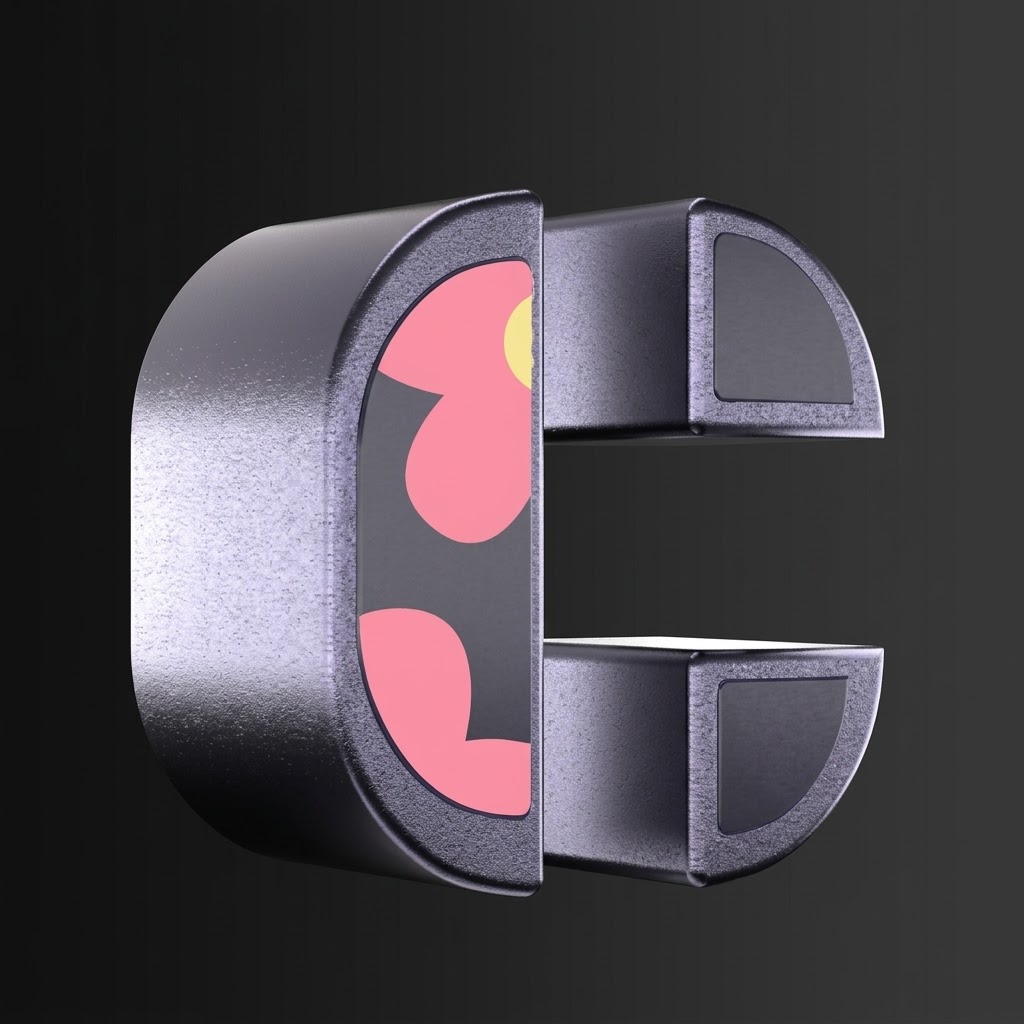
3D-printed directional signs can support customized shapes, raised graphics, and complex geometries. However, 3D printing is a manufacturing method rather than a universal replacement for traditional modular signage. Aluminum extrusion systems remain suitable for projects requiring replaceable information panels, standardized components, and future expansion. The choice depends on accessibility requirements, design complexity, durability, and project budget.
Source & Expertise
This article is based on the company information and manufacturing capabilities supplied by Cosun Sign, including its modular signage product range, material options, manufacturing history, and project experience.
Accessibility references are based on the U.S. Department of Justice’s 2010 ADA Standards for Accessible Design, particularly Sections 216 and 703. Project-specific accessibility requirements should be confirmed with the responsible design and compliance professionals.
Last Updated: October 2026

 粤公网安备44030702001648号