

















A building facade can look almost unchanged for years, while its exterior signage may gradually lose color, develop surface defects, or show signs of corrosion.
This difference is not usually caused by one poor material choice. Outdoor signage performance is the result of how the building environment, material, surface finish, fabrication, and installation work together.
For architects, developers, and signage buyers, the important question is therefore not simply “Which material is most durable?” but:
“Which signage system is appropriate for this building, this environment, and this expected service life?”
Why Does Outdoor Signage Deteriorate Faster Than the Building Facade?
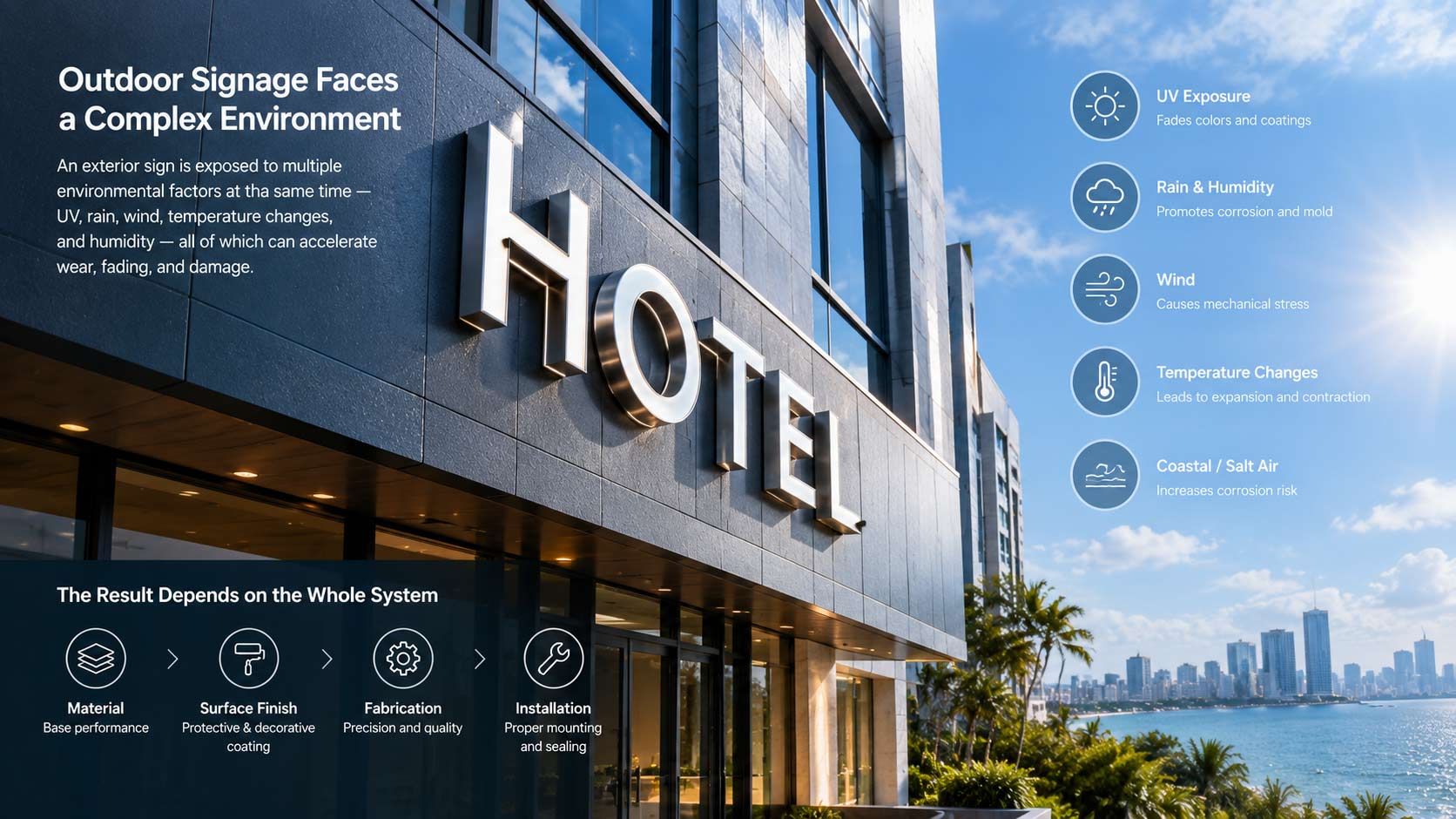
The first step is to understand the environment around the sign.
An exterior sign mounted on a high-rise facade may face strong UV exposure, wind, rain, and large temperature changes. A wayfinding sign in a sheltered entrance may experience much less stress. A coastal hotel can face a different challenge again, where humidity and airborne salt increase the risk of corrosion.
Consider a typical commercial development. The architectural facade may use carefully specified exterior materials, while its signage is treated as a final decorative element. The sign is then exposed to the same environment without necessarily receiving the same level of material and finish specification.
This is where problems often begin.
Engineering Note
Signage should be specified as part of the building environment, not as an isolated graphic element.
Before selecting materials, a project team should consider:
- Geographic location
- UV exposure
- Rain and humidity
- Coastal or industrial conditions
- Temperature variation
- Wind exposure
- Mounting position
- Expected service life
- Maintenance accessibility
The same sign specification can perform very differently in two locations.
How Does UV Exposure Cause Signage Colors and Surfaces to Fade?
UV radiation is one of the main causes of visible aging on exterior signs.
Continuous sunlight can gradually degrade pigments, coatings, plastics, and printed graphics. Depending on the material and finish, the result may be color fading, gloss loss, surface chalking, or embrittlement.
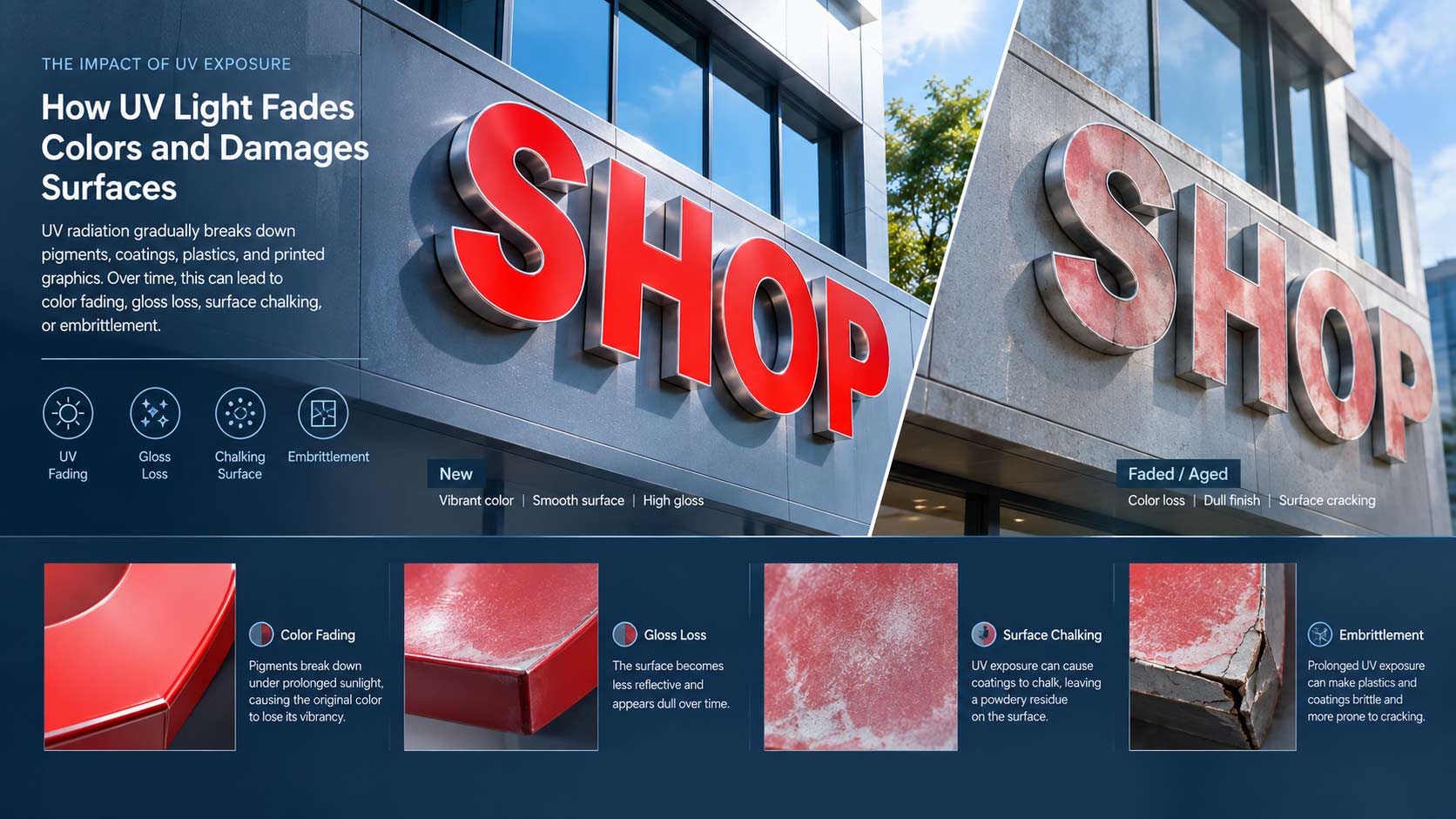
This becomes especially noticeable when a sign forms part of a building’s identity system.
Imagine a retail development where the brand color is specified precisely across the facade, entrance, and wayfinding system. If the exterior sign uses a finish that is not suitable for prolonged sunlight exposure, the sign may slowly develop a different tone from the surrounding brand elements.
The issue is not simply cosmetic. Color consistency is part of architectural and brand communication.
Why Material and Finish Must Be Considered Together
A durable substrate does not automatically provide a durable appearance.
For exterior applications, the specification should consider both the base material and the protective or decorative finish. Coating quality, surface preparation, coating thickness, curing, and exposure conditions can all affect long-term performance.
Engineering Note
For projects with high solar exposure, material and finish selection should be evaluated according to expected UV exposure rather than selected only for initial appearance.
Why Can Metal Signs Corrode Even When the Metal Itself Is Durable?
Corrosion is often more complicated than simply choosing a “corrosion-resistant” material.
A metal sign can contain several components: the face, returns, brackets, fasteners, internal frames, mounting hardware, and electrical components. These parts may interact with moisture and each other differently.
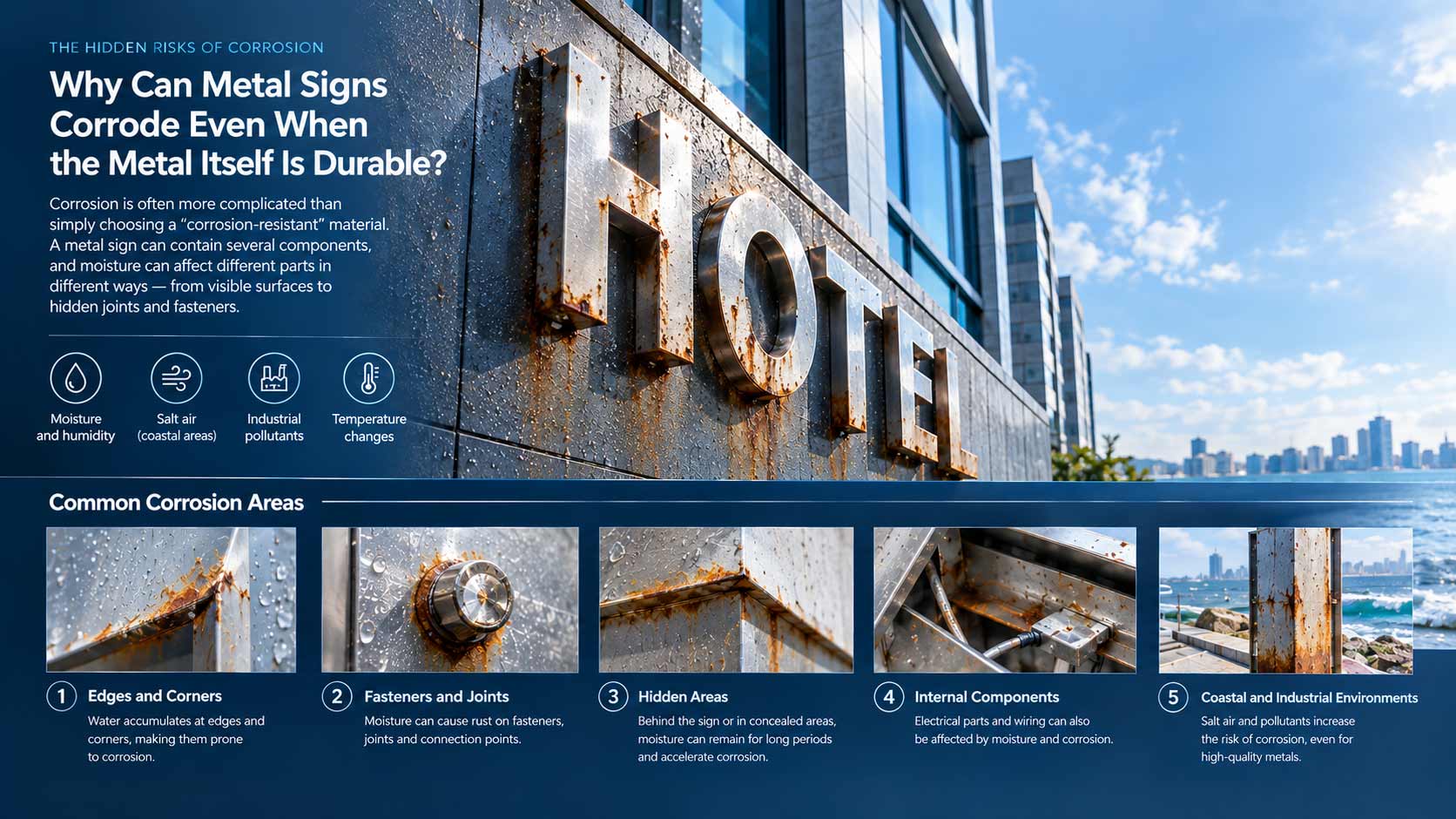
For example, a coastal project may use metal signage throughout an outdoor pedestrian area. The visible face may remain in good condition while corrosion begins around fasteners, joints, edges, or concealed areas where moisture accumulates.
This is why the engineering review needs to go beyond the visible surface.
Choosing Aluminum for Lightweight Exterior Signage
Aluminum is frequently selected for architectural and wayfinding signage because it combines relatively low weight with good corrosion resistance and fabrication flexibility.
It can be suitable for:
- Exterior wayfinding systems
- Building identification
- Dimensional letters
- Sign cabinets
- Architectural wall signs
Its relatively low weight can also simplify mounting on building facades and secondary structures.
Choosing Stainless Steel for Architectural Appearance and Strength
Stainless steel is a common choice when both a high-end look and structural integrity are needed.
Finishes like brushed, satin, or polished can fit smoothly into modern building designs.
At a luxury hotel entrance, for instance, stainless steel signage might be used not just for its longevity, but to match the visual character of stone, glass, and other metal surfaces around it.
The appropriate stainless steel grade should still be considered according to the exposure environment.
Engineering Note
Material selection should balance corrosion resistance, structural requirements, weight, appearance, fabrication method, and environmental exposure.
There is no universally “best” signage material.
Why Does Surface Treatment Matter as Much as the Base Material?
A common specification mistake is to identify the metal but not adequately specify its finish.
Two signs made from the same aluminum substrate can have very different long-term performance depending on their surface treatment.
Powder coating, PVDF coating, anodizing, brushed finishes, and other treatments each serve different aesthetic and engineering purposes.
Powder Coating for Exterior Signage
Powder coating can provide a consistent architectural finish across aluminum and other compatible substrates.
However, its durability depends on more than the powder itself.
The complete process can involve:
Surface preparation → Pretreatment → Coating application → Curing → Inspection
If surface preparation is inadequate, the coating system may not achieve its intended performance even when the final color looks correct.
PVDF Coating for Demanding Architectural Applications
PVDF coating systems are widely associated with architectural metal applications where long-term weathering and color performance are important.
For large exterior projects with significant sunlight exposure, the coating specification may therefore become an important part of the facade and signage strategy.
The objective is not simply to choose a premium coating. It is to match the coating system with the environmental and performance requirements of the project.
Engineering Note
The visible finish is the final result of a process, not simply a color selection.
When evaluating an outdoor sign, ask not only “What color is it?” but also “How is that finish produced and protected?”
How Should Signage Materials Change According to the Project Environment?
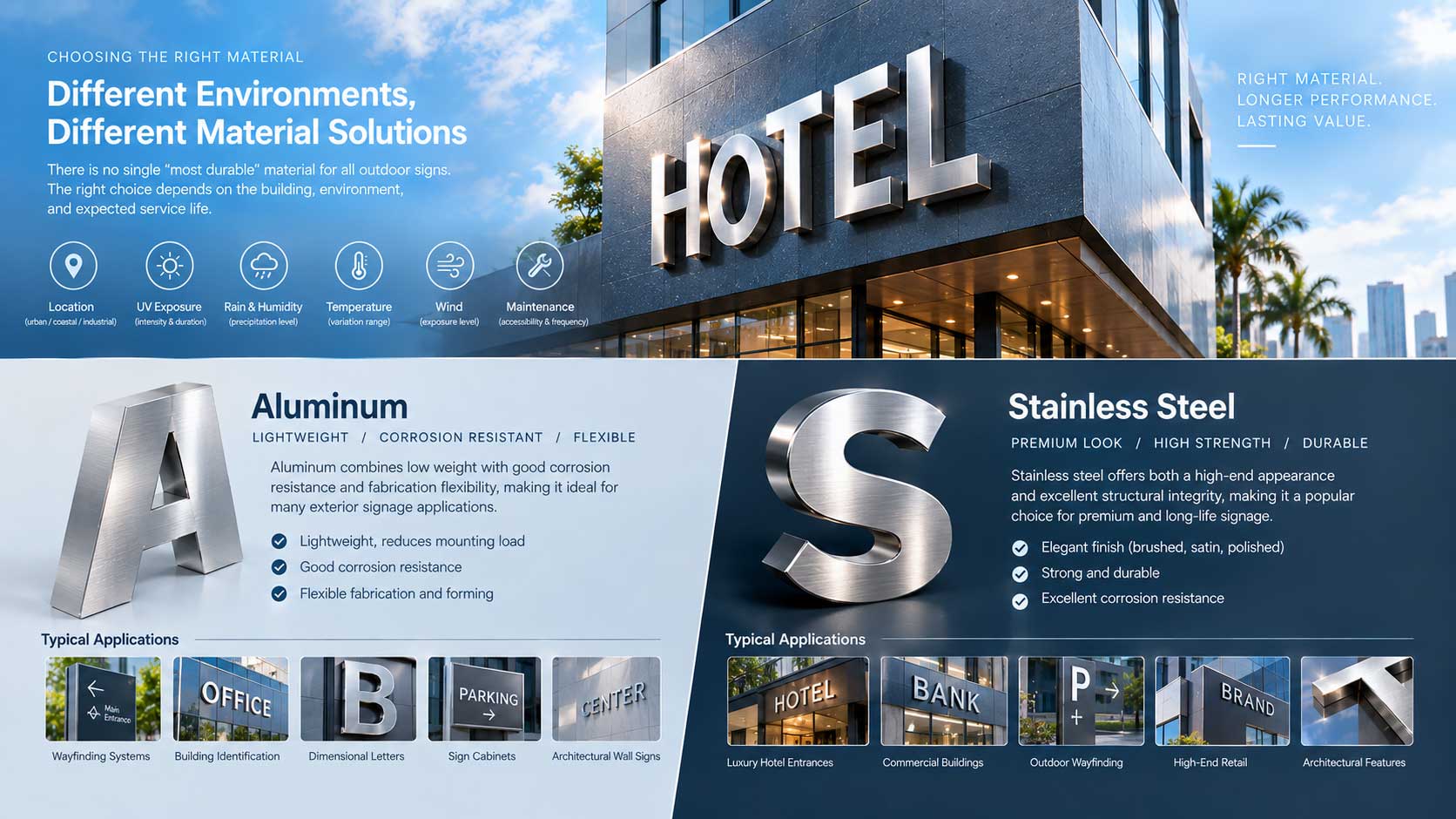
Once the architectural and environmental conditions are understood, material selection becomes much more logical.
Consider four common project scenarios.
Urban Commercial Building
A sign mounted on a city facade may face sunlight, rain, dust, pollution, and daily temperature changes.
Aluminum with an appropriate exterior finish can provide a practical balance between weight, durability, appearance, and fabrication flexibility.
Coastal Hotel or Resort
A coastal project introduces higher humidity and airborne salt.
Here, corrosion resistance becomes a more significant design consideration. Material grades, protective finishes, fasteners, joints, and maintenance access should all be reviewed together.
High-UV Location
In regions with intense sunlight, long-term color stability becomes particularly important.
The finish should therefore be selected according to its expected UV and weathering performance rather than based only on a showroom sample.
Premium Architectural Development
For a high-end office tower, hotel, or mixed-use development, the sign must perform technically while also matching the architectural language.
Stainless steel, architectural aluminum, and carefully controlled surface finishes may be considered where material appearance is part of the design intent.
Engineering Note
The right signage specification changes with the environment.
A sign that performs well in a sheltered entrance may not be the right solution for an exposed rooftop or coastal facade.
Why Do Fabrication Details Affect Signage Durability?
Even the correct material and coating can perform poorly if the sign is not fabricated correctly.
This becomes particularly important for dimensional letters, large sign cabinets, and exterior wayfinding structures.
Edges, seams, corners, joints, drainage paths, and internal cavities can all influence how water moves through the sign.
For illuminated signage, the challenge becomes greater because the system may contain LEDs, wiring, power supplies, and access panels.
A well-designed sign should therefore consider not only how it looks from the front, but also what happens behind the visible surface.
A Typical Fabrication Decision
Imagine a large exterior sign cabinet installed on a facade that receives heavy rain.
Instead of simply sealing every opening, the engineering approach should consider how water enters, where it can accumulate, and how it can drain.
This can influence:
- Joint design
- Edge treatment
- Internal structure
- Drainage
- Sealing
- Access panels
- Electrical protection
Engineering Note
Durability is often determined by details that are invisible after installation.
The sign face may be the most visible component, but joints, fasteners, internal structures, and drainage details can have a major influence on service performance.
Why Is Installation Part of Signage Durability?
Manufacturing quality does not end at the factory gate.
Installation introduces another set of engineering variables: substrate condition, fixing method, alignment, wind exposure, access, and site tolerances.
A sign designed for a concrete wall may require a different mounting solution on a curtain wall, steel structure, stone facade, or other architectural surface.
For a large exterior identification sign, mounting components must also be considered in relation to the sign’s weight and environmental loads.
Poor installation can create stresses that were not present in the original design.
Manufacturing and Installation Are Different Engineering Stages
Manufacturing focuses on:
- Material processing
- Fabrication accuracy
- Surface treatment
- Assembly
- Electrical integration
- Quality inspection
Installation focuses on:
- Site conditions
- Substrate
- Mounting system
- Alignment
- Structural fixing
- Waterproofing
- Electrical connection
- Final inspection
Treating these as separate but connected stages helps reduce installation-related failures.
What Should Buyers Check Before Ordering Outdoor Signage?
A professional outdoor signage specification should answer more than the question of appearance.
Before placing an order, project teams should confirm:
- Material
What substrate and material grade are being used? - Surface treatment
What finishing system is specified, and is it suitable for the exposure environment? - Fabrication
How are joints, edges, seams, drainage, and internal structures handled? - Electrical protection
For illuminated signs, how are LEDs, wiring, and power components protected? - Mounting
What fixing system is being used, and is it appropriate for the substrate and sign dimensions? - Maintenance
Can key components be accessed for inspection, repair, or replacement? - Environmental suitability
Has the specification been reviewed against UV, moisture, corrosion, temperature, and wind conditions?
Lessons from Outdoor Signage Projects
A recurring lesson from exterior signage projects is that long-term performance cannot be secured by material selection alone.
The strongest results usually come from decisions made early in the project, when the design team can still adjust materials, finishes, structural details, mounting systems, and maintenance requirements.
Once a sign is fabricated and installed, correcting an unsuitable specification becomes much more expensive.
How Can a Signage Manufacturer Improve Long-Term Outdoor Performance?
The manufacturer’s role is not simply to turn a drawing into a finished sign.
For complex architectural projects, the manufacturer connects several stages:
Design Review → Material Selection → Engineering → Fabrication → Surface Treatment → Assembly → Quality Control → Installation Coordination
Each stage affects the next.
For example, an environmental requirement may influence the material. The material may influence fabrication. The fabrication method may influence joints and mounting. The mounting system may influence installation planning.
This is why signage durability is best approached as a system-level engineering decision.
At COSUN SIGN, our approach to architectural and outdoor signage integrates material selection, fabrication, finishing, quality control, and installation coordination to address the requirements of each project environment.
Final Takeaway: Durable Outdoor Signage Starts with the Right Engineering Decisions
Signs fade, crack, discolor, and corrode for many different reasons. In most cases, the problem cannot be explained by the word “material” alone.
Outdoor signage durability depends on five connected decisions:
Environment → Material → Surface Treatment → Fabrication → Installation
When these factors are considered together, signage can better maintain its appearance, structural integrity, and functional performance throughout its intended service life.
For architects, developers, and signage buyers, the most important question is therefore not:
“What is the most durable material?”
It is:
“What signage system is appropriate for this specific building, environment, and service requirement?”
That shift—from choosing a material to designing a complete system—is the foundation of more reliable outdoor signage.

 粤公网安备44030702001648号