

















The signage industry has become an essential part of urban wayfinding, commercial branding, architectural communication, and smart tourism infrastructure. What was once largely based on simple sign and shopfront production has gradually developed into a specialized manufacturing ecosystem with clear divisions of labor and strong connections between different stages of the supply chain.
The sign manufacturing industry chain can generally divided into four major segments: raw materials, signage components, smart hardware and software, and signage manufacturing factories.
Each segment plays a different role in the industry. Understanding how these segments interact helps explain how the modern signage manufacturing industry operates.
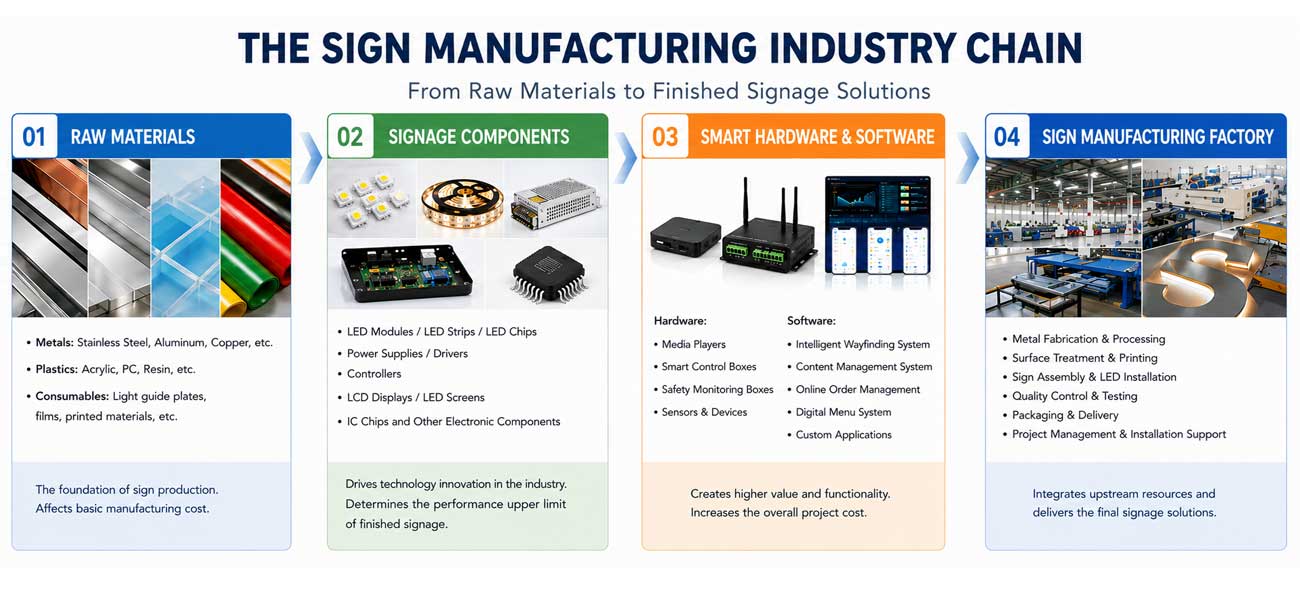
Upstream: Signage Raw Materials
Raw materials are the starting of sign manufacturing and form the foundation of the signage supply chain.
Common materials used in sign production include metal sheets such as stainless steel, aluminum, and copper, as well as non-metallic materials such as acrylic, polycarbonate (PC), Rowmark, and resin. Other commonly used materials and consumables include light guide plates, films, printed graphics, and advertising fabrics.
Material selection depends heavily on the application, design requirements, environment, durability expectations, and manufacturing process.
For example, aluminum is widely used where lightweight environment and corrosion resistance are important, while stainless steel is often selected for applications requiring durability and a premium appearance. Acrylic and polycarbonate are commonly used for illuminated signage and other applications requiring light transmission or forming capabilities.
The raw material segment is mature. Changes in metal, plastic, acrylic, and other material prices mainly affect the manufacturing cost of finished signage.
In a typical signage project, the material account for only 20% of the total cost.
Key Upstream Segment: Signage Components
Signage components represent another important upstream segment and have a much stronger influence on the technological development of illuminated and digital signage.
These most important components include: LED chips and LED packages, LED light strips, LED modules, Power supplies and drivers, Controllers, LCD displays, LED display panels, IC and etc.
Component technology directly affects signage products.
For illuminated signs, improvements in LED efficiency, brightness, color consistency, thermal management, power efficiency, and control technology can influence the design and manufacturing of the final product.
For digital signage, the development of displays, players, controllers, communication systems, and other electronic components continuously expands what a signage manufacturer can deliver.
This creates a strong relationship between component innovation and sign manufacturing. These components are used in far smaller quantities than raw materials, yet they account for 25% 30% of the total cost.
Midstream Segment: Smart Signage Hardware and Software
Smart hardware and software have become an increasingly important part of the signage industry over the past decade.
Traditional signage mainly communicates information through static physical graphics. The integration of digital hardware, software, connectivity, and control systems allows signage to become more dynamic, interactive, and remotely manageable.
The hardware include: Digital media players, Smart control boxes, Safety control box, monitoring devices, Display controllers,communication devices
The software include: Digital wayfinding systems, Content management systems, Online ordering and project management platforms, Digital menu, Remote turn on and off soft ware, and other customized software depending on where it used.
The combination of these technologies has created new categories such as digital signage, smart wayfinding, digital pylon, digital hanging sign, digital blade sign, interactive kiosk, and dynamic information displays.
Smart hardware and software can therefore create additional value beyond the physical sign itself. However, digital integration also increases system complexity and increase the total cost of a signage project.
COSUN SIGN has develop digital signage from 2014, one of the earliest digital signage R&D enterprises.
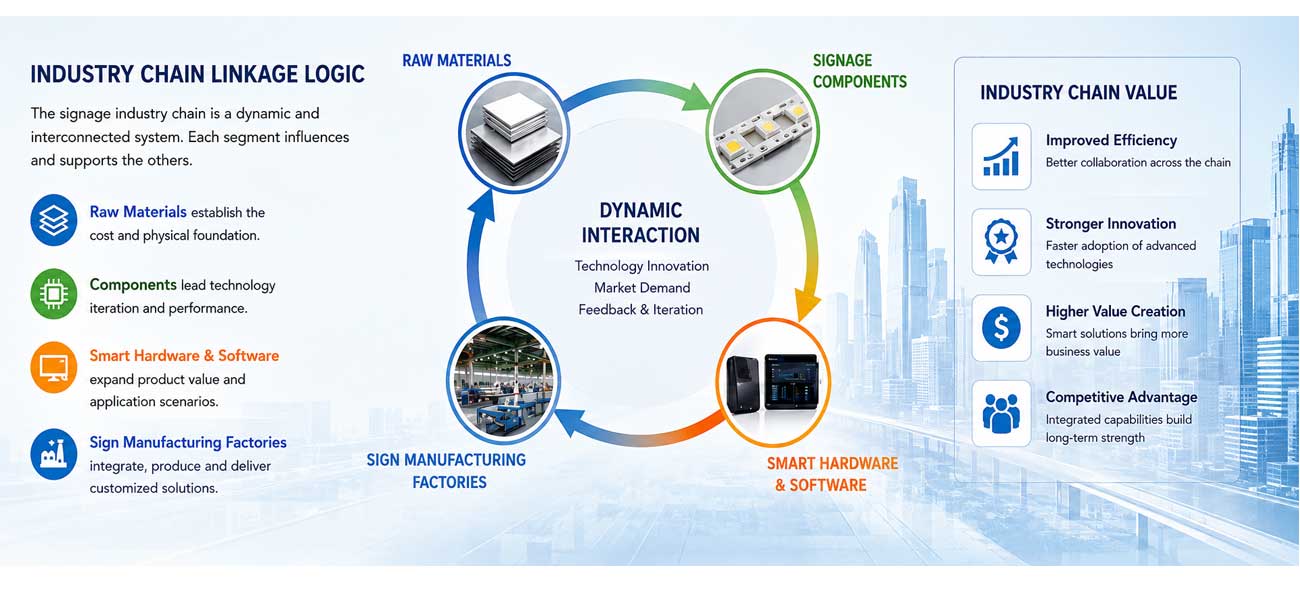
Downstream: Sign Manufacturing Factories
Sign manufacturing factories are the downstream segment of the signage supply chain.
After the sign product designed, sign factory processing various raw material, assemble accessories,and ultimately manufacture all kinds of signage products.
A professional signage manufacturing factory may provide capabilities such as:
- Metal fabrication
- Sheet metal processing
- Laser cutting
- CNC machining
- Bending machine
- Acrylic processing
- Welding
- Surface finishing
- LED installation
- Sign assembly
- Quality inspection
- Packaging and shipping
Depending on the project, a manufacturer may also coordinate engineering, prototyping, installation support, and project management.
Unlike standardized mass-production industries, signage manufacturing is highly customized. A hospital wayfinding system, retail store sign package, hotel signage project, transportation sign system, and architectural facade sign may all require completely different materials, structures, finishes, lighting systems, and installation methods.
As a result, a competitive signage manufacturer needs more than basic fabrication capabilities.
It increasingly requires a combination of manufacturing expertise, engineering capability, product development, quality management, supply chain management, and modern factory operations.
The signage industry is gradually moving from traditional fabrication toward a more integrated combination of manufacturing, electronics, digital technology, and intelligent systems.
For signage manufacturers, following component technology is becoming increasingly important. At the same time, investment in smart signage applications, AI design,digital wayfinding, and quality management can help manufacturers respond to increasingly complex customer requirements.


 粤公网安备44030702001648号