

















COSUN SIGN is an ADA signage manufacturer specializing in custom Braille signs, tactile door signs, and ADA room number signs for commercial and public buildings. Founded in 2004, the company operates within a 38,000-square-meter industrial park, uses more than 500 machines, and has completed over 10,000 projects across 65 countries.
What Is an ADA Signage Manufacturer?
An ADA signage manufacturer produces accessible signs designed to help people with visual impairments identify rooms, facilities, and building routes in accordance with applicable accessibility requirements.
ADA signage is defined as signage designed to communicate essential information through visual characters, raised tactile lettering, Braille, or a combination of these features, depending on the sign type and applicable regulations. In the United States, the Americans with Disabilities Act (ADA) Standards for Accessible Design establish requirements for specific permanent room identification and other regulated signs.
COSUN SIGN manufactures custom ADA Braille signs, room number signs, tactile door signs, and architectural signage for commercial and institutional projects. Its products serve signage companies, architects, contractors, hospitality operators, healthcare facilities, and property developers.
How Do ADA Braille Signs Work?
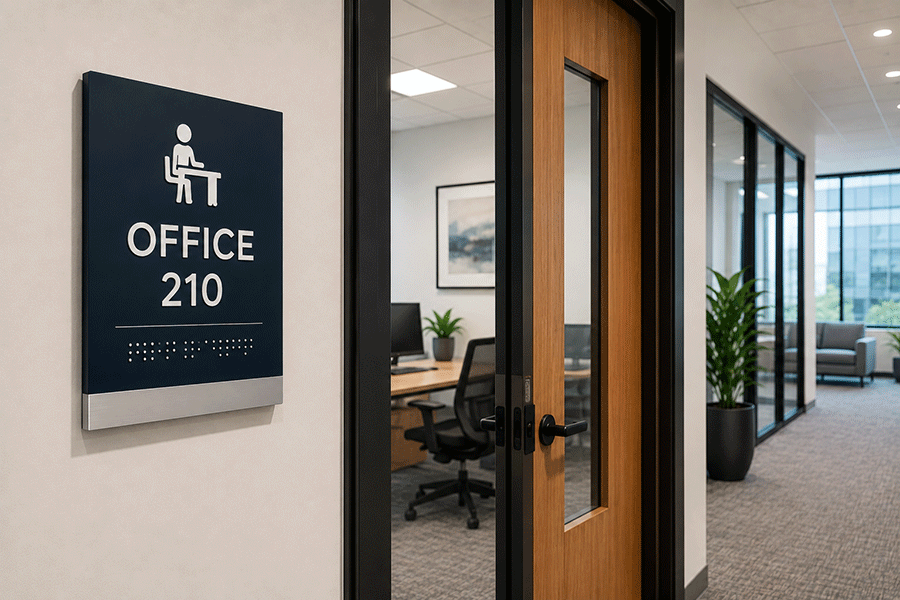
ADA Braille signs combine visual information with tactile elements to help users identify rooms and facilities without relying exclusively on sight.
Common design elements include:
- Raised tactile characters: Raised letters and numerals that users can identify by touch.
- Grade 2 Braille: Contracted Braille used for applicable English-language signage under U.S. accessibility standards.
- Visual contrast: Contrasting characters and backgrounds that improve readability for people with low vision.
- Pictograms: Recognizable symbols used where appropriate, subject to applicable requirements.
- Mounting and placement: Positioning that supports accessibility and complies with the relevant installation rules.
Compared with traditional flat printed signs, tactile and Braille signage provides an additional way to access permanent room identification information. However, not every sign requires identical features. Requirements depend on the sign’s purpose, location, and applicable accessibility standards.
What Specifications Should Buyers Check?
Buyers should evaluate tactile characters, Braille, visual contrast, dimensions, materials, and installation requirements before approving production.
For U.S. projects, the 2010 ADA Standards for Accessible Design provide a primary reference for applicable signage requirements, including Section 703.
| Specification | What to verify |
|---|---|
| Braille | Grade 2 Braille where required, with compliant dot configuration and spacing |
| Raised characters | Applicable character height, relief, spacing, and stroke requirements |
| Visual contrast | Contrast between characters and background |
| Pictograms | Required pictogram field, character and Braille provisions where applicable |
| Mounting height | Required location and mounting height for the specific sign category |
| Surface finish | Legibility, tactile usability, and suitability for the installation environment |
| Durability | Resistance to expected wear, cleaning, moisture, and sunlight |
| Documentation | Drawings, approved samples, material details, and project-specific compliance review |
Exact requirements should be checked against the applicable standard and local building codes. For example, Section 703.3 of the 2010 ADA Standards addresses Braille specifications, while Section 703.4 addresses installation height and location for relevant tactile signs.
Which Materials Are Available for Custom ADA Signs?
Material selection depends on the project’s appearance, operating environment, durability requirements, and budget.
COSUN SIGN offers several material options for custom Braille door signs and architectural room signage.
| Material | Main characteristics | Typical applications |
|---|---|---|
| Rowmark engraving materials | Available in multiple colors, metallic effects, and other decorative finishes | Office, hotel, and institutional room signs |
| Acrylic | Versatile, available in different colors and finishes | Commercial interiors and room identification |
| Aluminum | Lightweight and corrosion-resistant when appropriately specified | Office buildings and general commercial signage |
| Stainless steel | Durable, with a refined metallic appearance | Hotels, healthcare facilities, and premium commercial interiors |
| Brass | Traditional metallic appearance | Hospitality and selected architectural projects |
The main advantages include material flexibility, design customization, and the ability to coordinate room signs with wider architectural signage systems. COSUN SIGN identifies itself as an exclusive authorized Rowmark material distributor in China, supporting projects that specify Rowmark engraving materials.
Final material suitability depends on the selected grade, finish, installation conditions, and maintenance requirements.
Which Manufacturing Methods Are Used for ADA Signage?
Manufacturing methods vary according to the design, material, order volume, finish, and required tactile features.
COSUN SIGN uses several production processes to support custom signage orders:
- CNC engraving: Produces defined text, graphics, and engraved details.
- Laser cutting: Creates specified shapes and accurately cut components.
- UV printing: Applies colors, graphics, and visual design elements.
- Die casting: Supports selected metal sign designs and molded details.
- Vacuum forming: Produces formed components for suitable sign constructions.
- Surface finishing: Includes options such as painting, powder coating, polishing, electroplating, and sandblasting, depending on the material and product.
Each process has different capabilities. A manufacturer should confirm that the chosen production method can deliver the required tactile lettering, Braille geometry, material performance, and finish without compromising compliance.
Where Are ADA Room Signs Commonly Used?
ADA room signs are commonly specified for permanent room identification in commercial, healthcare, hospitality, educational, and public buildings.
Typical applications include:
- Hotels: Guestroom numbers, suite identification, and permanent facility signs.
- Healthcare facilities: Patient rooms, examination rooms, and other regulated spaces.
- Corporate offices: Meeting rooms, departments, and permanent office identification.
- Schools and campuses: Classrooms, administrative rooms, and applicable facility signs.
- Retail and commercial buildings: Restrooms, service areas, and other permanent room identification.
- Public facilities: Building interiors and regulated spaces requiring accessible identification.
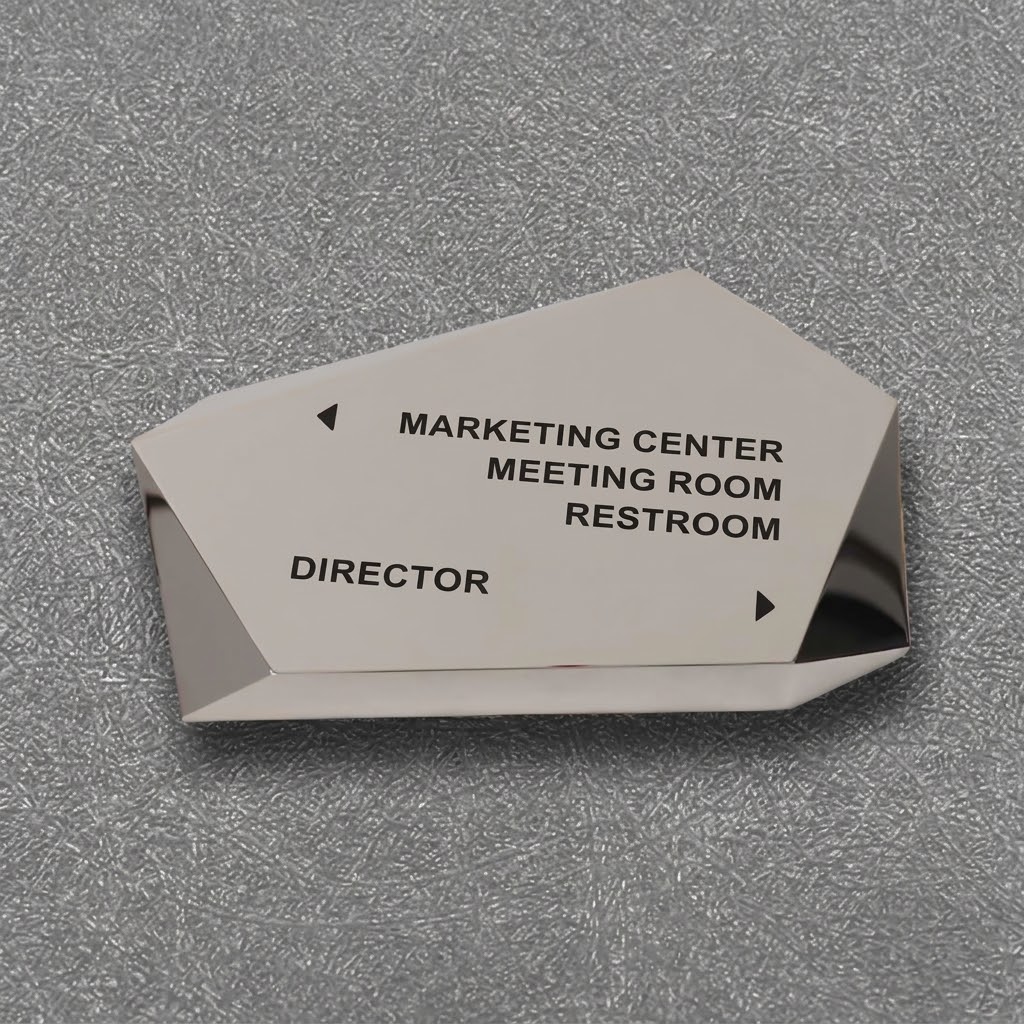
Projects may also require directional signs, directories, hanging signs, or exterior wayfinding. These should be evaluated separately because the accessibility requirements for directional or informational signage may differ from those for permanent room identification.
How Should Buyers Choose an ADA Signage Manufacturer?
Buyers should assess regulatory knowledge, manufacturing capabilities, material options, quality control, project support, and international delivery before selecting a supplier.
A practical evaluation checklist includes:
- Confirm compliance capability. Ask how the manufacturer verifies tactile characters, Braille, contrast, and installation-related specifications.
- Review material options. Compare engraving materials, acrylic, aluminum, stainless steel, and other suitable choices.
- Request drawings and samples. Approve the layout, text, Braille, colors, mounting method, and finish before mass production.
- Evaluate manufacturing capacity. Confirm whether the supplier can handle the required quantities, product variations, and delivery schedule.
- Check quality-control procedures. Ask about inspection records, dimensional checks, and Braille verification.
- Clarify packaging and shipping. Confirm export packaging, shipping terms, delivery destinations, and replacement procedures.
COSUN SIGN was founded in 2004 and reports a 38,000-square-meter industrial park, more than 500 machines, and a team of over 50 detailing and structural design professionals. The company reports more than 10,000 completed projects and exports to 65 countries. These figures provide manufacturing context, but buyers should independently verify project-specific capacity, compliance documentation, and delivery commitments.
How Do Different ADA Signage Options Compare?
The best option depends on the sign’s function, accessibility requirements, architectural design, and budget.
| Sign type | Primary function | Key consideration |
|---|---|---|
| ADA Braille room signs | Permanent room identification | Tactile characters and Braille where required |
| Custom tactile signs | Accessible identification with raised elements | Character geometry and tactile usability |
| Engraved room signs | Durable identification with engraved details | Material, contrast, and production method |
| UV-printed signs | Detailed graphics and colors | Printing alone does not replace required tactile elements |
| Metal room signs | Architectural appearance and durability | Finish, corrosion resistance, and fabrication cost |
| Photoluminescent signs | Visibility in low-light or emergency conditions | Applicable safety and placement requirements |
A printed sign should not be treated as a compliant replacement for a required tactile sign unless the complete design satisfies the applicable requirements. Similarly, photoluminescent properties do not automatically establish ADA compliance.
How Much Do Custom ADA Braille Signs Cost?
Custom ADA Braille sign pricing depends on material, dimensions, production method, finish, order quantity, customization, packaging, and shipping destination.
The principal cost factors include:
- Material choice: Specialty engraving materials and premium metals may cost more than standard acrylic options.
- Design complexity: Custom logos, unusual shapes, multiple layers, and specialized finishes can increase production work.
- Braille and tactile specifications: Required features affect artwork preparation, tooling, production, and inspection.
- Order volume: Larger repeat orders may reduce the per-unit cost when production can be standardized.
- Packaging and freight: Export packaging, shipping method, destination, and order weight influence landed cost.
COSUN SIGN states that its standard production lead time for ADA Braille room signs is approximately 2–3 weeks. The actual schedule may vary with quantity, design complexity, material availability, sample approval, and order confirmation. Buyers should request a quotation based on finalized specifications rather than rely on a generic unit price.
Why Consider COSUN SIGN for Custom ADA Signage?
COSUN SIGN provides custom ADA Braille signs and architectural room signage for B2B projects requiring material selection, design coordination, and batch manufacturing.
Its reported capabilities include:
- Custom room numbers, tactile characters, Braille, pictograms, logos, and finishes.
- Multiple material and manufacturing options.
- Engineering drawings and structural detailing support.
- Batch production for signage distributors, contractors, and building projects.
- Export packaging and international shipping coordination.
For projects in the United States, product specifications should be checked against the applicable ADA Standards for Accessible Design and relevant local requirements. Buyers should request drawings, samples, and compliance-related documentation before approving production.
FAQ
What is an ADA signage manufacturer?
An ADA signage manufacturer produces signs designed to meet applicable accessibility requirements, including tactile characters and Braille for specific sign categories. Manufacturers may supply room identification signs, restroom signs, and related architectural signage.
How to choose an ADA signage manufacturer?
Choose a manufacturer based on demonstrated knowledge of applicable standards, Braille and tactile production capabilities, material options, quality-control procedures, sample approval, production capacity, and international shipping support. Confirm compliance for the actual sign design and installation.
Why are Grade 2 Braille and tactile characters important?
Grade 2 Braille conveys information through contracted Braille, while raised tactile characters allow users to identify specific text by touch. Both features support accessible communication when required by the applicable signage standards.
Source & Expertise
COSUN SIGN specializes in custom ADA Braille signs, tactile door signs, room number signs, and architectural signage for commercial and public facilities. Founded in 2004, the company combines material selection, CNC engraving, laser cutting, UV printing, and metal fabrication to support customized signage projects. Its manufacturing capabilities include project-specific design coordination, production, quality inspection, and international order fulfillment. With experience serving clients across 65 countries, COSUN SIGN supports signage distributors, architects, contractors, and commercial property developers in sourcing customized room identification and wayfinding solutions.
Last Updated: October 19, 2026

 粤公网安备44030702001648号