

















Accessible signage assists people with identifying rooms, locating destinations and navigating smoothly across various public and commercial facilities including offices, hospitals, hotels, schools and shopping centers. In the United States, the Americans with Disabilities Act (ADA) mandates specific accessibility standards for such signage, with the 2010 ADA Standards outlining clear requirements for tactile characters, Braille, visual fonts, color contrast, surface finish and sign placement to ensure inclusivity for all users.
This guide breaks down the key ADA signage requirements, covering ADA compliant signs, Braille signs and tactile signage.
What Is ADA Signage?
ADA signage refers to signs designed to meet applicable accessibility requirements.
Common examples include:
- ADA room signs
- Restroom signs
- Stairway signs
- Elevator signs
- Tactile signs
- Braille signs
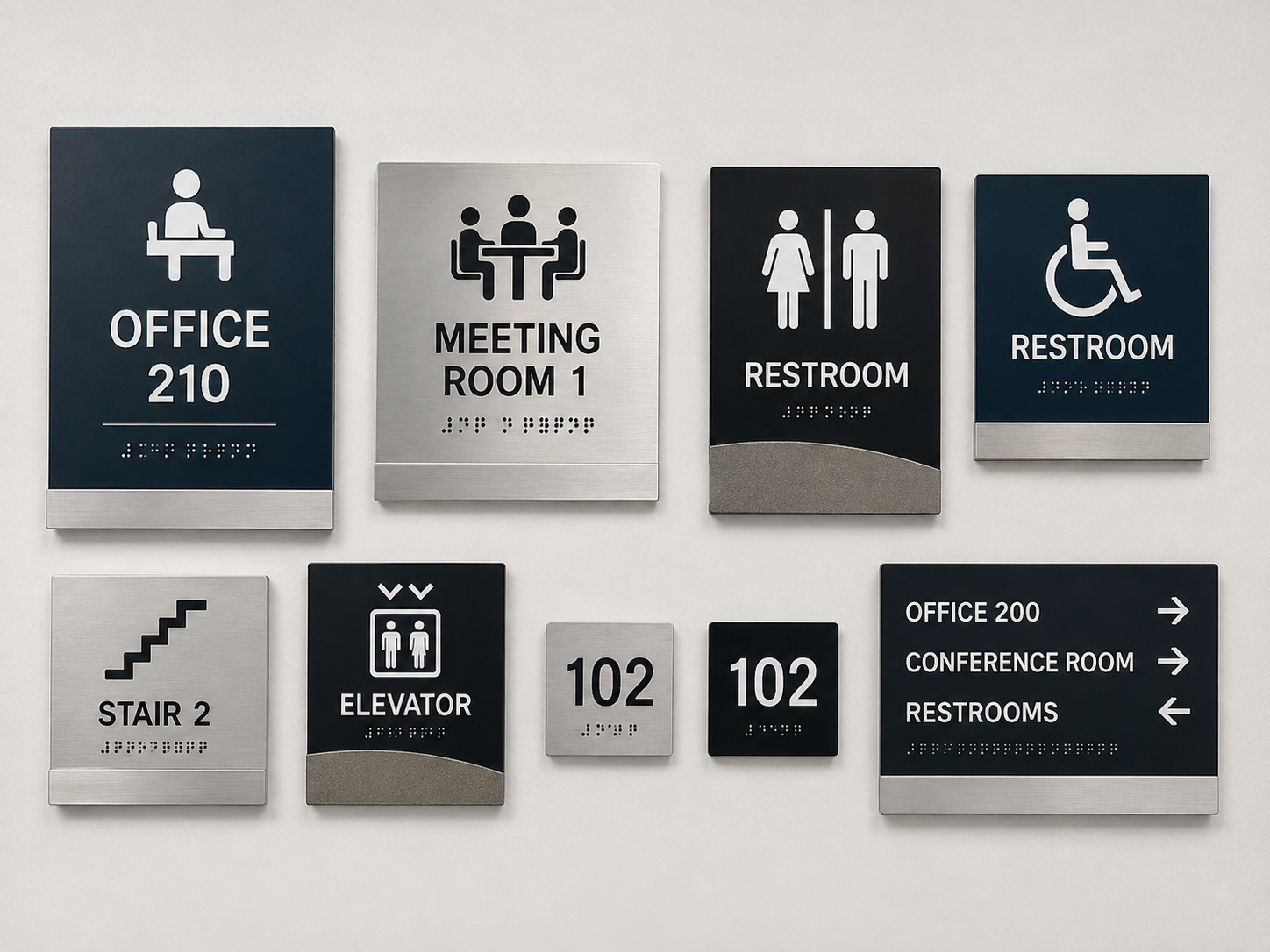
Not all signage follows the same set of rules. Signs marking permanent rooms and spaces are typically required to feature tactile lettering and Braille, whereas wayfinding and informational signage comply with separate regulatory clauses.
What Makes a Sign ADA Compliant?
An ADA compliant sign must satisfy specifications for tactile lettering, Braille formatting, character design, color contrast, surface finish, and installation position.
Tactile Signs
Tactile characters are raised letterforms readable through physical touch. Per the 2010 ADA Standards, raised characters need to protrude a minimum of 1/32 inch (0.8 mm) from the sign background, and meet defined standards for uppercase formatting, dimensional proportions, and font style.
Braille
Eligible ADA signage adopts contracted Grade 2 Braille. The official standards also outline strict rules for Braille sizing, spacing and mounting position. Braille elements need to be integrated into sign layouts at the design stage instead of being attached as an afterthought post production.
Contrast and Finish
ADA signage also considers visual readability. Characters should provide sufficient contrast with the background, and applicable signs require a non glare finish.
Do ADA Signs Require Braille?
Not every sign requires Braille.
The 2010 ADA Standards distinguish between permanent room or space identification signs and directional or informational signs. Permanent room identification signs generally require tactile characters and Braille, while directional signs are subject to different requirements.
The purpose of each sign should therefore be determined before production.
Where Are ADA Signs Required?
ADA compliant signage is deployed in a wide range of commercial and public settings.
Offices and Corporate Buildings
ADA room identification signs label offices, conference rooms, restrooms, stairwells and other permanently designated spaces.
Hospitals and Healthcare Facilities
Medical facilities typically implement a full signage ecosystem consisting of ADA room signs, tactile signage, Braille markers, directional signs and dedicated wayfinding components.
Hotels
Hospitality properties install accessible signage to mark guest rooms, restrooms, elevators, stairwells and other fixed permanent areas.
Schools and Universities
Accessible signs may be used throughout classrooms, offices, libraries, laboratories, restrooms, and other permanent spaces.
Shopping Malls and Retail Buildings
Retail environments may combine ADA signage with directories and wayfinding systems for restrooms, elevators, service areas, and other applicable locations.
Types of ADA Signs
ADA Room Signs
ADA room signs identify permanent rooms and spaces such as offices, classrooms, meeting rooms, treatment rooms, and restrooms.
Tactile Signs
Tactile signs feature raised letters, numerals and symbols designed for touch based reading. Popular manufacturing materials include acrylic, metal and dedicated tactile substrates.
Braille Signs
Braille signs incorporate Braille into the sign face. Tactile lettering, Braille positioning, spacing, and overall layout should be considered together during production.
ADA Wayfinding Signs
ADA wayfinding signs support navigation through directional information, floor identification, room signs, and other navigation elements.
Not every directional sign requires Braille or tactile lettering under the same provisions as permanent room identification signs.
ADA Signage Requirements for Tactile and Braille Design
| Design Element | Key Requirement |
| Raised characters | Minimum 1/32 in (0.8 mm) |
| Character case | Uppercase |
| Character style | Sans serif |
| Braille | Contracted Grade 2 Braille |
| Braille position | Below corresponding tactile text |
| Tactile signs height | 5/8 in (16 mm) to 2 in (51 mm) |
| Mounting height | 48 in (1220 mm) to 60 in (1525 mm), as specified |
| Finish | Non glare |
| Visual contrast | Characters should contrast with background |
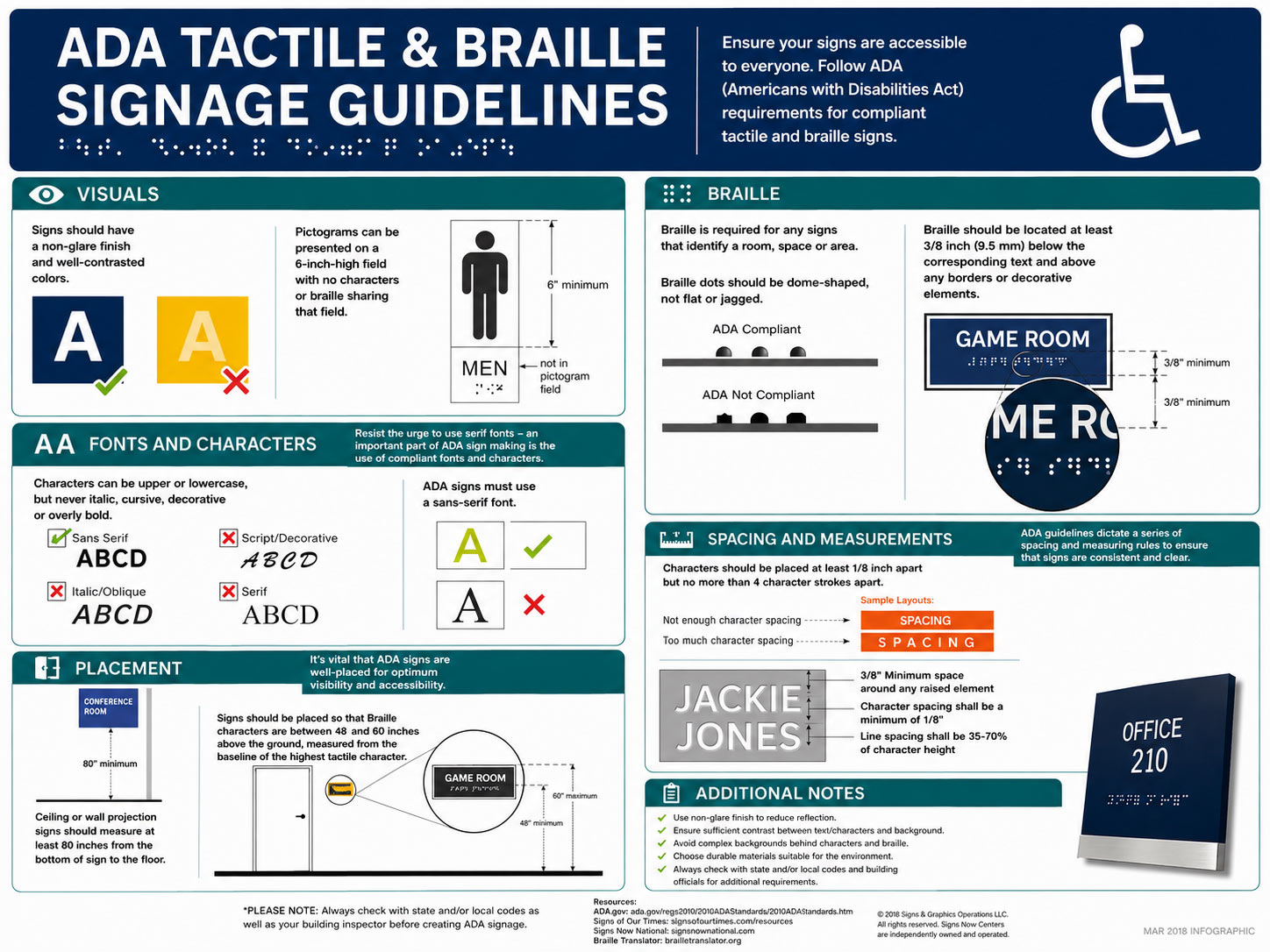
These requirements are based on Section 703 of the 2010 ADA Standards. Applicable local building, fire, and accessibility requirements should also be reviewed.
ADA Signs vs. Standard Signs
| Feature | Standard Sign | ADA Sign |
| Visual text | Commonly used | Used where applicable |
| Tactile characters | Not always required | Required for applicable types |
| Braille | Usually not included | Required for applicable types |
| Contrast | Design dependent | Accessibility requirements apply |
| Finish | Design dependent | Non glare requirements apply |
| Installation | Project dependent | Specific requirements may apply |
The difference becomes important on large commercial projects where many signs must follow one specification.
How to Design an Effective ADA Signage System
Start With the Building Plan
Identify permanent rooms, elevators, stairs, restrooms, circulation routes, and other key locations. Then determine which signs require tactile characters, Braille, visual information, or directional information.
Separate Identification From Direction
Room identification answers “What is this space?” while directional signage answers “Where do I go?”
Keeping these functions separate makes the signage easier to understand.
Keep the Sign Family Consistent
Materials, colors, finishes, mounting methods, and graphic details can be coordinated across the project while maintaining required tactile and Braille features.
Consider Installation Before Production
Door swings, wall conditions, adjacent fixtures, clear floor space, and mounting height should be checked before manufacturing.
Common Mistakes in ADA Sign Design
Adding Braille at the last minute.
Braille should be included in the original layout.
Using decorative fonts for tactile text.
Tactile characters must meet applicable character requirements.
Ignoring surface glare.
Reflective finishes can reduce readability.
Treating every sign the same.
Room identification, directional signs, and directories have different functions.
Choosing mounting locations too late.
Installation site conditions should be assessed prior to manufacturing.
How to Choose an ADA Compliant Signage Manufacturer
A reliable ADA compliant signage supplier needs deep expertise in tactile lettering, Braille formatting, material selection, surface finishes, mounting hardware, and full project specification compliance.
Large scale projects often need ADA room identification signs, directional signs, building directories, floor level markers, restroom signs, and custom wayfinding components. Your manufacturer should be capable of harmonizing all these products under a unified signage program.
COSUN SIGN delivers custom signage solutions for commercial and architectural spaces, including ADA compliant signs, tactile signage, integrated wayfinding systems, and other custom built sign products.
Frequently Asked Questions About ADA Compliant Signage
What are ADA signage requirements?
ADA signage standards regulate tactile characters, Braille formatting, visual typography, color contrast, surface finishes, mounting height, and sign placement. Exact specifications change depending on each sign’s type and intended use.
Do ADA signs need Braille?
Permanent room and space identification signs generally require tactile characters and Braille. Directional and informational signs follow different requirements.
What are Braille signs?
Braille signs feature Braille dots on the sign surface, allowing users to read information by touch.
What are tactile signs?
Tactile signs have raised up characters and symbols that can be interpreted through touch.
Where are ADA signs required?
ADA compliant signage is widely required for offices, hotels, medical facilities, K 12 & higher education campuses, retail spaces, and other commercial and public access buildings.
What is the difference between ADA signs and Braille signs?
ADA compliant signs follow official accessibility standards. Braille signs are specifically fitted with Braille text. A standard ADA sign typically includes both tactile lettering and Braille.
Can ADA signs be customized?
Yes. ADA compliant signs support custom options for size, substrate material, color, surface finish, mounting style, tactile lettering, Braille formatting, and visual graphic design.
Final Considerations
Plan for accessible signage early in the building design phase, instead of adding it as an after thought.
Key details including tactile lettering, Braille, color contrast, surface finish and mounting location form a complete wayfinding system for hospitals, hotels, office premises, educational campuses and shopping malls.
A solid grasp of ADA signage, Braille signs, tactile signs and ADA wayfinding products empowers project teams to pick suitable location specific solutions, while keeping full accessibility and consistent architectural styling.



 粤公网安备44030702001648号