

















Every industry has different requirements for signage. A hotel needs to guide guests while maintaining a welcoming environment, a healthcare facility must prioritize clear navigation and accessibility, and a retail or commercial property may place greater emphasis on visibility, tenant information, and brand consistency. At COSUN SIGN, we believe effective signage should be selected according to the environment, audience, operational requirements, and long-term maintenance needs of each business. Our custom signage solutions are developed to support practical applications rather than force different industries into the same product model.

Start with the Customer Journey in Hospitality
Hospitality environments are built around guest movement. Visitors may enter through a main entrance, pass through a lobby, locate elevators, find restaurants or meeting spaces, and eventually reach their rooms. For this reason, business signage in hotels should be considered as part of the complete guest journey rather than as individual signs placed around a property.
We approach hotel signage by separating brand communication from functional navigation. Three-dimensional channel letters and halo-lit letters can create a recognizable focal point in reception areas or lobby brand walls. These elements can reinforce the hotel’s visual identity while also providing a defined location where guests naturally interact with the brand.
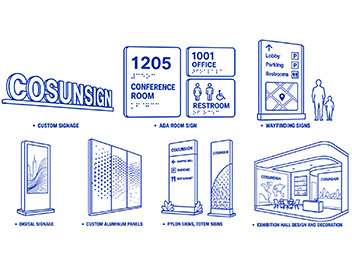
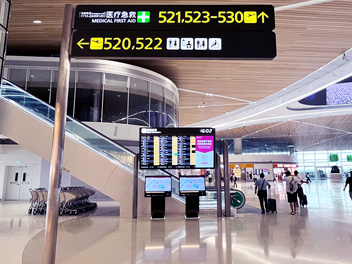
Navigation requires a different approach. Directional signs, floor directories, room identifiers, and digital information displays can help guests understand where they are and where they need to go. When these elements are positioned according to actual traffic patterns, hotel employees can spend less time providing basic directions and more time handling services that require direct assistance.
Material selection also changes according to location. Pool areas, spas, outdoor entrances, and other humid environments can expose signage to moisture and chemicals. We therefore consider corrosion resistance, surface treatment, mounting conditions, and cleaning requirements when developing custom signage for hospitality projects.
Build Healthcare Signage Around Clarity and Accessibility
Healthcare facilities present a more complex navigation challenge because visitors may be unfamiliar with the building and may already be under pressure when they arrive. Business signage in hospitals and clinics therefore needs to communicate information clearly without adding unnecessary visual complexity.
We recommend planning healthcare wayfinding as a continuous system. Outdoor signs can identify entrances and parking areas, while directories near elevators can provide broader orientation. Directional signs then guide visitors toward departments, treatment areas, and other destinations. Room plaques complete the process by identifying the final location.
This layered approach is more practical than relying on one type of sign to solve every navigation requirement. It also allows the signage system to accommodate different building layouts and visitor flows. During the planning stage, we consider viewing distances, sign placement, typography, contrast, and the relationship between directional information and architectural features.
Accessibility is another essential consideration. Custom signage for healthcare environments can incorporate tactile information, Braille, appropriate contrast, and multilingual content where required by the project. These features should be incorporated during design rather than added after installation, helping organizations create a more consistent and accessible environment from the beginning.
Digital displays can complement permanent signs when information changes frequently. Department names and fixed directions can remain on static signs, while schedules, temporary announcements, or changing service information can be presented through digital systems. This combination provides flexibility without requiring the entire wayfinding system to be replaced whenever information changes.
Let Retail Signage Work with the Storefront
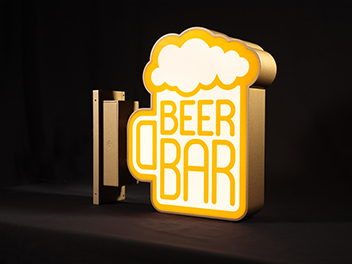
Retail signage has a different objective from healthcare or hospitality wayfinding. Customers often make their first impression of a store before entering it, so business signage needs to establish brand recognition while remaining visible within a competitive commercial environment.
Storefront channel letters are one option for businesses that need a strong exterior identity. Front-lit or halo-lit formats can be selected according to the brand style, architectural background, viewing conditions, and installation location. We can also work with defined brand colors and dimensional requirements to support consistency across multiple locations.
For retail groups with several stores, consistency becomes particularly important. Different storefront dimensions may require adjustments, but the relationship between logo proportions, colors, typography, illumination, and mounting should remain recognizable. A coordinated signage program helps maintain a unified brand presence without requiring every location to use exactly the same physical configuration.
Inside shopping centers, the role of custom signage extends beyond individual storefront identification. Directory signs and digital wayfinding systems can help visitors understand the layout of a property and locate specific tenants. Digital systems can also accommodate information that changes more frequently than conventional printed directories.
This creates an opportunity to connect navigation with commercial communication. A digital display can provide directions while also presenting permitted promotional or property information. The objective is not to add information for its own sake, but to make better use of locations where visitors already stop to orient themselves.
Adapt Commercial Buildings to Changing Tenants
Commercial real estate introduces another requirement: signage must often accommodate change. Office buildings may have multiple tenants, and tenant information can change over the course of a property’s operation. A fixed directory system can become inefficient when every update requires replacing an entire sign.
We address this issue through modular approaches. Business signage with replaceable panels can allow property managers to update tenant names and other relevant information without redesigning the complete directory. This can make maintenance more manageable and help preserve a consistent appearance throughout the building.
Lobby directories, floor identification, room signs, entrance signs, and parking information should also work together as one visual system. When each element follows a common design language, visitors can understand information more quickly and building owners can manage future updates more efficiently.
Custom signage can also support the architectural identity of commercial properties. Materials, finishes, dimensional elements, illumination, and mounting methods can be selected according to the building’s design. The signage should remain visible and functional without competing unnecessarily with the surrounding architecture.
Choose Materials According to the Operating Environment
Industry selection is only one part of the decision. The physical environment can be equally important. An exterior sign exposed to sunlight, rain, wind, or temperature changes requires different considerations from an interior directory installed in a controlled office environment.
We evaluate factors such as installation location, exposure conditions, required visibility, cleaning methods, expected usage, and maintenance access before recommending a signage solution. Materials and finishes should be selected according to these practical conditions instead of being chosen solely for appearance.
This approach also applies to illumination. LED lighting may be appropriate when signs need to remain visible during evening hours, while non-illuminated formats may be more suitable for certain indoor applications. The objective is to match the specification with the actual operating requirement.
Develop a Signage System That Can Evolve
A successful signage project should account for future needs rather than focusing only on the initial installation. Business signage may need to accommodate new tenants, revised branding, changes in building use, or updated information.
We therefore consider scalability during the design process. Modular components, standardized visual elements, replaceable information areas, and digital displays can provide different levels of flexibility depending on the project.
The right balance depends on the industry and property. A hotel may prioritize guest navigation and brand presentation, while a hospital may require accessibility and information clarity. Retail businesses may focus on storefront visibility, whereas commercial buildings may place greater emphasis on tenant management. There is no single signage format that serves all of these requirements equally well.
Build the Right Solution with COSUN SIGN
Choosing signage by industry allows businesses to connect visual communication with real operational requirements. Hospitality properties need guest-oriented navigation, healthcare facilities require accessible and intuitive information systems, retail businesses depend on visibility and brand consistency, and commercial properties benefit from adaptable tenant signage.
At COSUN SIGN, we develop custom signage and business signage solutions according to the specific environment, application, design requirements, and maintenance considerations of each project. With more than 20 years of manufacturing experience, we support businesses from signage planning and design through production and implementation. By treating signage as an integrated part of the customer environment, we help businesses develop signage systems that support practical navigation, brand communication, and long-term operational needs.

 粤公网安备44030702001648号