

















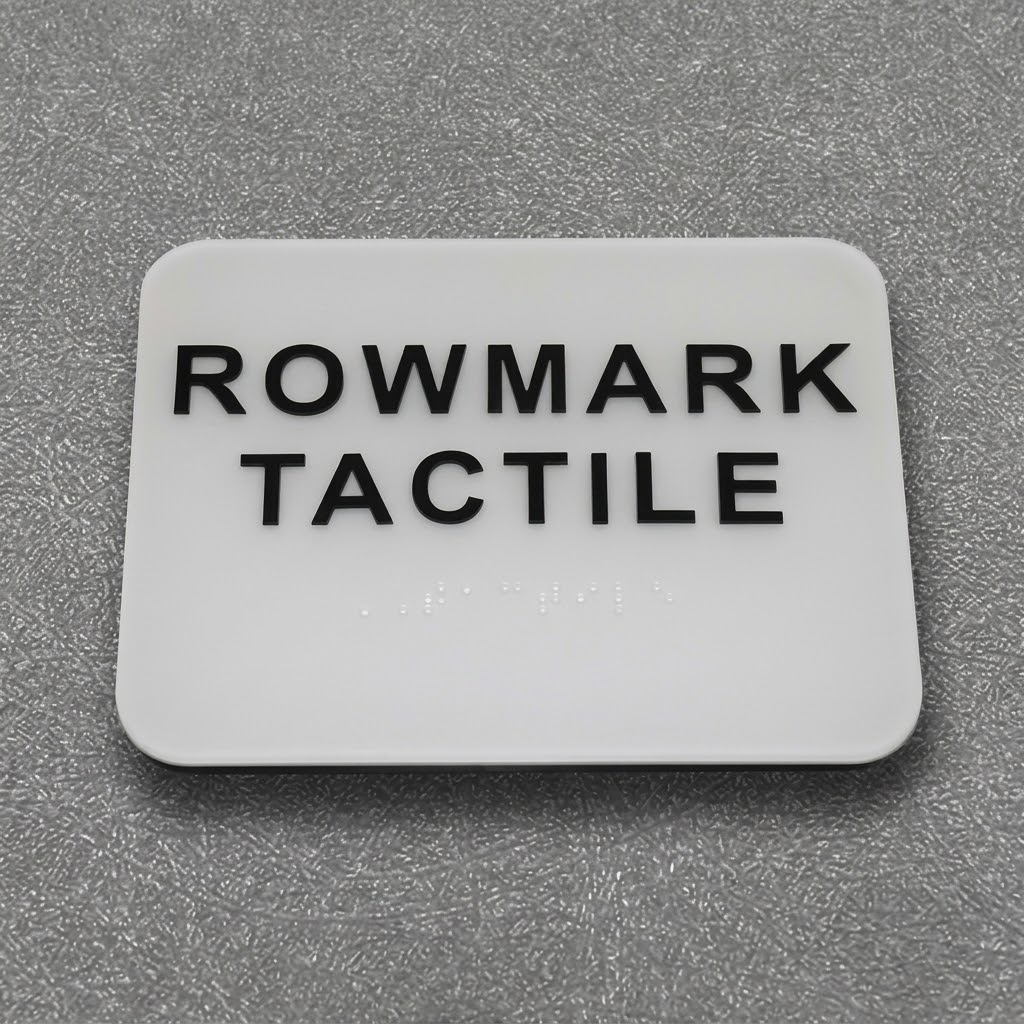
Cosun Sign is a custom signage manufacturer supplying Rowmark Tactile ADA Signs made from engraving-grade plastic for accessible room identification and indoor wayfinding. These signs can feature raised characters at least 1/32 inch (0.8 mm) above the background and Grade 2 contracted Braille. Material selection, character dimensions, contrast and installation must be evaluated against applicable accessibility requirements.
What Are Rowmark Tactile ADA Signs?
Rowmark Tactile ADA Signs are signs made from engraving-grade plastic that combine raised lettering and Braille to support accessible identification of permanent rooms and spaces.
The product is defined as a tactile identification sign manufactured using Rowmark ADA Alternative engraving material, with customizable dimensions, colors, text and mounting options. Under the 2010 ADA Standards for Accessible Design, Section 703, applicable tactile signs must meet requirements for raised characters, Braille and installation.
The main advantages include:
- Tactile accessibility: Raised characters and Grade 2 Braille help people with visual impairments identify permanent room labels.
- Material flexibility: Rowmark engraving sheets offer color and finish options for different interior signage systems.
- Custom fabrication: Room numbers, names, pictograms and project-specific layouts can be produced according to approved drawings.
- Installation flexibility: Adhesive backing or mechanical mounting can be specified according to the substrate and project requirements.
How Are Rowmark ADA Signs Manufactured?
Rowmark ADA signs are typically produced through material selection, graphic preparation, engraving, tactile-feature fabrication, inspection and finishing.
A typical manufacturing workflow includes:
- Material selection: Choose an appropriate Rowmark ADA Alternative sheet based on the required color combination, finish and fabrication method.
- Artwork preparation: Confirm room names, numbering, symbols, character dimensions and Braille transcription against the approved sign schedule.
- Engraving and fabrication: Apply compatible engraving or routing processes to produce the specified visual design. Raised characters and Braille must be fabricated using suitable methods that achieve the required tactile dimensions.
- Finishing and inspection: Check edges, surface condition, contrast, character placement, Braille geometry and overall dimensions.
- Mounting preparation: Supply the specified adhesive or mechanical fixing arrangement and installation information.
The exact process depends on the selected material, sign design and production specification. Buyers should confirm whether raised characters are formed directly from the selected material or added through a separate fabrication process.
What Are the Core Technical Specifications?
The principal specifications concern tactile height, character geometry, Braille dimensions, surface finish and mounting.
| Parameter | Specification or requirement |
|---|---|
| Material | Rowmark ADA Alternative engraving plastic |
| Raised character depth | Minimum 1/32 inch (0.8 mm) above the background under ADA Section 703.2.1 |
| Braille | Grade 2 contracted Braille where required |
| Braille dot shape | Domed or rounded |
| Surface finish | Non-glare finish where required |
| Color selection | Custom combinations subject to contrast requirements |
| Mounting | Adhesive or mechanical fixing, subject to project conditions |
| Dimensions | Customized to approved drawings and applicable standards |
Where Are Rowmark Tactile ADA Signs Used?
Rowmark tactile signs are commonly specified for indoor identification and wayfinding in commercial, healthcare and hospitality environments.
Typical applications include:
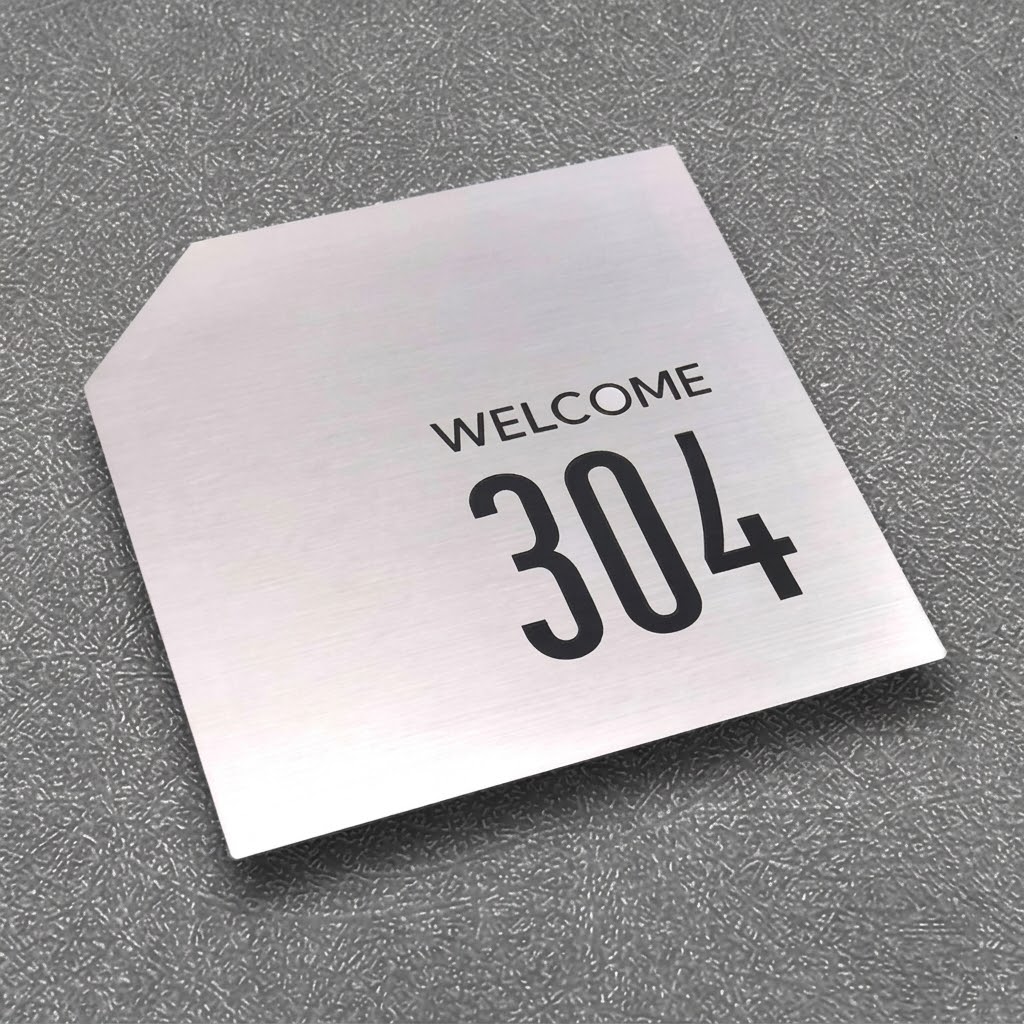
- Hotels: Guest-room numbers, restroom identification and permanent facility labels.
- Hospitals and healthcare facilities: Room identification, treatment-area labels and accessible public facilities.
- Offices and commercial buildings: Meeting rooms, offices, shared spaces and permanent room designations.
- Schools and campuses: Classrooms, administrative offices, laboratories and accessible facilities.
- Public buildings: Permanent room identification and other locations where tactile signage is required.
Architects, interior designers, general contractors and facility managers should coordinate sign schedules, mounting locations and accessibility requirements before production.
How Can Buyers Select a Reliable Signage Manufacturer?
A reliable signage manufacturer should demonstrate material familiarity, repeatable fabrication quality, accurate Braille production and the ability to follow approved project specifications.
When evaluating a Rowmark tactile ADA signs manufacturer, buyers should review:
- Material sourcing: Confirm the material grade, supplier authorization where relevant and product traceability.
- Technical capability: Ask how the manufacturer controls raised-character dimensions, Braille dot geometry and spacing.
- Compliance procedures: Check the production drawings against ADA Section 703 and applicable local building requirements.
- Quality control: Request samples, dimensional inspection records and documented acceptance criteria.
- Project coordination: Confirm custom sizing, color options, mounting hardware, packaging and delivery arrangements.
- Documentation: Verify which certificates apply to the company, materials or finished products rather than assuming that a company certificate establishes ADA compliance.
ASTM D3359-23 covers tape-test methods for evaluating the adhesion of relatively ductile coating films to metallic substrates. It may be relevant to suitable coated components, but it is not a general ADA compliance test for plastic signage. Test methods should be selected according to the actual material and performance requirement.

How Do Rowmark Signs Compare With Traditional Signage Solutions?
Compared with traditional solutions, Rowmark tactile signs offer a material-based approach to combining engraved visual information with tactile room identification, while other processes may provide different design or production options.
| Production approach | Typical characteristics | Key consideration |
|---|---|---|
| Rowmark engraving plastic | Multiple colors and finishes; suitable for engraving | Verify tactile features and material compatibility |
| Printed flat signage | Flexible graphics and detailed color reproduction | Flat printing alone does not provide required raised characters |
| 3D-printed signage | Complex shapes and integrated raised features may be possible | Verify Braille accuracy, surface finish and applicable tolerances |
| Metal signage | Rigid construction and a different visual appearance | Confirm tactile fabrication method and installation suitability |
No single process is appropriate for every project. Material durability, design complexity, order quantity, accessibility requirements and installation conditions determine the preferred solution.
What Factors Affect Custom ADA Sign Costs?
Custom ADA sign costs depend on material, dimensions, design complexity, production methods and order requirements.
Key cost factors include:
- Material and finish: Sheet type, color combination, thickness and surface finish.
- Sign dimensions: Larger signs generally require more material.
- Tactile fabrication: Raised characters, Braille, symbols and inspection requirements affect processing.
- Customization: Unique layouts, pictograms and nonstandard sizes may require additional preparation.
- Mounting and packaging: Adhesive options, mechanical hardware and project-specific packing affect the final quotation.
- Order quantity: Repeated designs and consolidated orders may change setup and unit costs.
For an accurate quotation, provide the quantity, dimensions, sign schedule, artwork, preferred colors, mounting method and destination.
Why Choose COSUN SIGN for Rowmark Tactile ADA Signs?
COSUN SIGN is a custom signage manufacturer serving commercial, healthcare and hospitality projects with configurable signage products and fabrication services.
The company identifies itself as an authorized general distributor of Rowmark in mainland China. Its stated product capabilities include custom dimensions, multiple color and finish options, raised lettering, Braille fabrication, pictograms and different mounting arrangements. Common materials are stocked to support order responsiveness, subject to actual inventory and project requirements.
COSUN SIGN also reports holding UL and CE certificates. Buyers should request the relevant documentation and verify its scope for the intended application. These certifications should not be interpreted as proof that every sign meets ADA requirements.
Project-specific production capacity and daily output have not been provided. For larger orders, purchasers should request a confirmed lead time, sample approval process, inspection criteria and shipment schedule.
FAQ
What are Rowmark Tactile ADA Signs?
Rowmark Tactile ADA Signs are engraving-plastic signs designed to combine raised lettering and Braille for accessible room identification. Their final dimensions, finishes and installation must meet the applicable accessibility requirements.
How to choose a reliable Rowmark Tactile ADA Signs manufacturer?
Choose a manufacturer that can demonstrate appropriate material sourcing, accurate Grade 2 Braille fabrication, dimensional quality control, clear documentation and experience coordinating custom signage projects. Request samples and verify compliance before approving production.
Why choose 3D printed Rowmark Tactile ADA Signs over traditional options?
3D printing may suit projects that require complex geometry, integrated raised features or specialized customization. However, Rowmark engraved-plastic signs may be more appropriate when a project prioritizes established material options, engraved graphics and consistent room-sign designs. Neither process is automatically ADA-compliant; the finished sign must meet applicable requirements.
Source & Expertise
This article is based on COSUN SIGN’s supplied product information for Rowmark Tactile ADA Signs and the U.S. Department of Justice’s 2010 ADA Standards for Accessible Design, particularly Sections 703.2, 703.3 and 703.4. Material-specific test methods should be confirmed against the relevant technical documentation.
Last Updated
Last Updated: October 2026

 粤公网安备44030702001648号