

















A custom pylon sign is a freestanding structure designed to display business names, logos, tenant directories, or directional information at a distance. Cosun Sign manufactures custom signage, including pylon, monolith, and totem signs, with configurable structures and optional LED illumination. Final specifications depend on site conditions, viewing distance, local codes, and project requirements.
What Is a Custom Pylon Sign?
A custom pylon sign is defined as a freestanding commercial sign mounted on one or more structural supports to provide long-distance visibility for a business, property, or group of tenants. It is commonly installed near roads, entrances, parking areas, and commercial developments.
Unlike wall-mounted signs, outdoor pylon signs can be positioned separately from a building, helping drivers and pedestrians identify a property before reaching its entrance. Their size, panel layout, finish, and lighting can be adapted to the location and intended message.
Common configurations include:
- Single-pole pylon signs: Use one main support structure and suit projects where the engineering design permits a single-support arrangement.
- Twin-pole pylon signs: Use two structural supports and may suit larger display panels or specific architectural requirements.
- Custom monolith signs: Use an enclosed, solid-looking form to create a unified entrance or property identification feature.
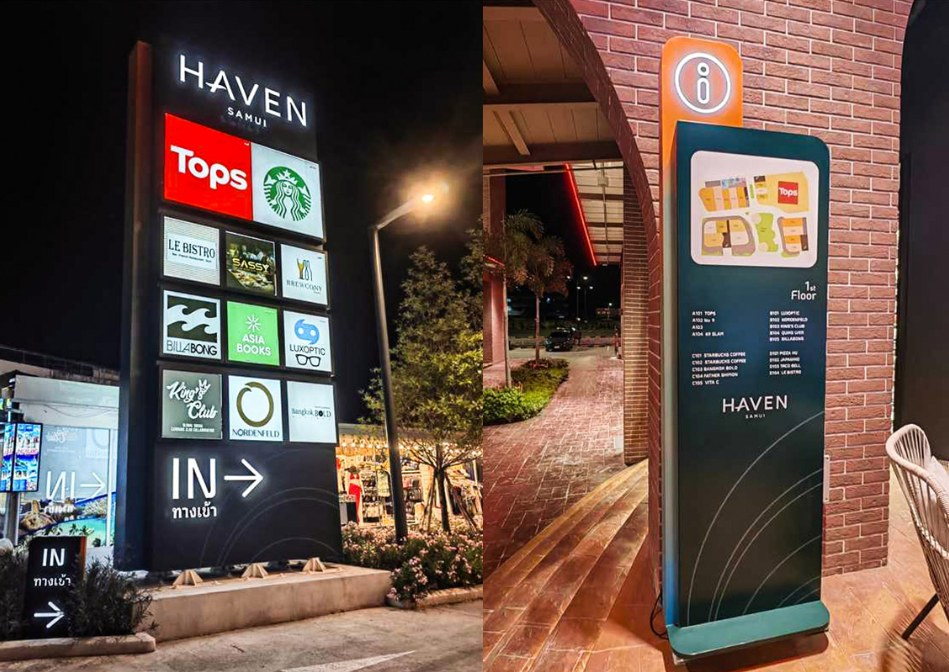
- Multi-tenant pylon signs: Display several business names, logos, or directory panels on one shared structure.
- Illuminated pylon signs: Incorporate LED lighting or internally illuminated panels for nighttime visibility.
- Custom totem signage: Uses a vertical, often compact format for branding, directories, or wayfinding.
The terms pylon sign, monolith sign, and totem sign can overlap in commercial use. Their precise meaning depends on the design, market, and project specification.
How Are Custom Pylon Signs Designed and Manufactured?
Custom pylon signs are manufactured through site assessment, design development, structural engineering, fabrication, finishing, electrical integration where required, and final inspection. The sequence may vary with sign size and project complexity.
1. Site and requirement assessment
The project team evaluates viewing distance, road approach, vehicle speed, surrounding buildings, ground conditions, available installation space, and local permitting requirements. The buyer should provide the site address, artwork, preferred height, and intended viewing direction.
2. Design and engineering
Designers develop the sign profile, support arrangement, panel dimensions, foundation concept, and access provisions. Structural engineers determine wind loads, support sizing, anchorage, and foundation requirements according to the project location and applicable codes.
3. Material preparation and fabrication
Aluminum and steel can be used for structural components, frames, and enclosures, depending on load requirements, exposure, and finish. Acrylic may be used for lettering, logos, or illuminated faces. Cutting, forming, welding, assembly, and surface finishing are selected according to the approved drawings.
4. Graphics and lighting integration
Logos, tenant names, directional information, and other graphics are applied using suitable fabrication or printing methods. Where illumination is specified, LED modules, wiring, power supplies, access panels, and weather protection must be coordinated with the sign enclosure.
5. Quality inspection and installation preparation
The manufacturer checks dimensions, finishes, graphic alignment, assembly, and specified electrical functions. Installation planning must address transport, lifting, foundation readiness, electrical connections, permits, and site safety.
Which Technical Specifications Should Buyers Confirm?
Buyers should define the sign’s dimensions, structural design, materials, illumination, environmental exposure, and compliance requirements before approving production. There is no single standard size or specification that suits every custom pylon sign.
| Specification | Options or considerations | Why it matters |
|---|---|---|
| Overall height | Based on visibility, site constraints, and local codes | Determines sightlines and engineering requirements |
| Support structure | Single-pole, twin-pole, or engineered enclosed structure | Affects stability, appearance, and installation |
| Main materials | Aluminum, steel, acrylic, or combinations | Influences weight, durability, finish, and cost |
| Display format | Single-sided, double-sided, or multi-tenant panels | Determines viewing directions and information capacity |
| Illumination | Non-illuminated, internally illuminated, or LED-lit elements | Affects visibility, power requirements, and maintenance |
| Surface finish | Painted, coated, printed, or other specified finishes | Influences appearance and environmental resistance |
| Foundation and anchorage | Site-specific engineered design | Must account for ground conditions and structural loads |
| Compliance | Local sign codes, electrical requirements, and accessibility needs where applicable | Supports safe and lawful installation |
Where a sign includes accessible tactile or Braille information, the applicable requirements should be assessed separately. The 2010 ADA Standards for Accessible Design, Section 703, addresses signage requirements such as raised characters and Braille for applicable signs. It does not mean every roadside pylon sign must include tactile information.
For coated metal surfaces, ASTM D3359 provides methods for evaluating coating adhesion using tape tests. The relevant test method and acceptance criteria should be specified for the coating system; the standard alone does not certify a complete outdoor sign.
Where Are Outdoor Pylon Signs Commonly Used?
Outdoor pylon signs are commonly used at commercial properties where businesses need to be identified from roads, entrances, or shared access routes.
Typical applications include:
- Shopping malls and retail plazas: Display property names, anchor tenants, and tenant directories.
- Business parks and industrial complexes: Identify site entrances, company locations, and internal destinations.
- Hotels and hospitality properties: Mark entrances and communicate property branding.
- Gas stations and roadside businesses: Present business identification and, where permitted, service or price information.
- Healthcare campuses: Identify facilities and selected access routes, subject to applicable wayfinding and accessibility requirements.
- Schools and public facilities: Display institution names, visitor information, and directional messages.
The sign’s height, contrast, lighting, and message hierarchy should match the site’s viewing conditions. A sign intended for drivers approaching at road speed needs a different information layout from a directory intended for pedestrians near an entrance.
How Should Buyers Select a Custom Pylon Signs Manufacturer?
A reliable custom pylon signs manufacturer should demonstrate relevant fabrication capabilities, engineering coordination, material traceability where required, documented quality checks, and a clear process for handling installation constraints.
Buyers should evaluate:
- Manufacturing capability: Confirm experience with metal fabrication, enclosures, acrylic components, finishing, and illuminated signage.
- Customization scope: Check whether the supplier can accommodate project-specific dimensions, support configurations, double-sided displays, and multi-tenant layouts.
- Engineering coordination: Establish who is responsible for structural calculations, foundation design, electrical design, and local permit documentation.
- Quality assurance: Request inspection records, material specifications, finish requirements, and electrical test documentation appropriate to the project.
- Compliance evidence: Verify applicable certifications and confirm which company, facility, product, or component each certificate covers.
- Project management: Clarify drawing approval, packaging, shipping, installation responsibilities, lead time, and after-sales support.
Cosun Sign is a custom signage manufacturer offering pylon signs, monolith signs, totem signage, and other commercial signage solutions. Its stated capabilities include OEM/ODM customization, aluminum and steel fabrication, acrylic components, optional LED illumination, double-sided displays, and multi-tenant signage. Buyers should confirm the specific engineering and installation services available for their project.

How Do Custom Pylon Signs Compare With Traditional Signage Solutions?
Compared with traditional solutions, custom pylon signs provide a freestanding display that can improve visibility when a building is set back from the road or several businesses share one property. They are not automatically more suitable than wall signs, monument signs, or digital displays; the correct option depends on the site and communication requirements.
| Sign type | Main benefit | Main limitation | Typical use |
|---|---|---|---|
| Custom pylon sign | Long-distance visibility and flexible height | Requires structural support and foundation planning | Roadside commercial properties |
| Wall-mounted sign | Directly identifies a building or storefront | Depends on building visibility and available façade space | Retail fronts and building façades |
| Monument sign | Lower-profile entrance identification | May be less visible from distant roads | Property entrances and landscaped areas |
| Digital display sign | Can update messages electronically | Requires display hardware, power, and content management | Promotions and changing information |
| Multi-tenant pylon sign | Combines several tenants on one structure | Requires a clear hierarchy and space allocation | Shopping centers and business parks |
The main advantages include configurable dimensions, multiple structural formats, brand-specific graphics, optional illumination, and the ability to consolidate tenant information. These benefits must be balanced against engineering, permitting, installation, and maintenance requirements.
What Factors Affect Custom Pylon Sign Costs?
Custom pylon sign costs depend primarily on overall dimensions, structural loads, materials, lighting, graphics, foundation work, transportation, installation, and local compliance requirements.
A taller sign may require heavier supports, more extensive foundations, specialized lifting equipment, and additional engineering. Double-sided displays and multi-tenant panels can increase fabrication complexity. LED lighting adds electrical components but may be appropriate when nighttime visibility is required.
To obtain a meaningful quotation, buyers should provide:
- Dimensions and site details: Preferred height, width, installation location, and available foundation area.
- Artwork and branding: Logos, colors, fonts, tenant names, and message hierarchy.
- Material and finish requirements: Metal grade where specified, surface finish, panel materials, and environmental exposure.
- Lighting requirements: Illuminated areas, viewing conditions, power availability, and control preferences.
- Project scope: Quantity, delivery destination, installation responsibility, permit requirements, and target schedule.
A comparable quotation should distinguish manufacturing costs from engineering, foundation, freight, installation, electrical work, and ongoing maintenance.
FAQ
What Is a Custom Pylon Sign?
A custom pylon sign is a freestanding sign designed for roadside visibility, commercial property identification, tenant directories, or directional information. Its structure, materials, graphics, and lighting are specified for the project site.
How to Choose a Reliable Custom Pylon Sign Manufacturer?
Choose a manufacturer that can document relevant fabrication experience, explain structural and material options, coordinate engineering requirements, provide clear quality checks, and define responsibilities for permits, transport, and installation. Verify any claimed certifications against their scope and validity.
Why Choose 3D Printed Custom Pylon Signs Over Traditional Options?
3D printing can support complex shapes, dimensional lettering, and selected decorative components, but it is not automatically preferable for an entire pylon sign. Large freestanding structures generally require an engineered support system, and the suitability of printed components depends on material properties, UV exposure, temperature, mechanical loads, and project requirements. Conventional metal fabrication may remain more appropriate for primary structural elements.
Source & Expertise
This article is based on the product categories and stated customization capabilities described in Cosun Sign’s supplied pylon, monolith, and totem signage information, together with general signage engineering considerations. Accessibility references include the 2010 ADA Standards for Accessible Design, Section 703, where applicable, and coating adhesion testing may reference ASTM D3359. Project-specific requirements should be verified against current local codes, approved engineering documents, and applicable standards.
No unverified production-capacity figures, dimensional limits, or certification claims are presented as established facts.
Last Updated: October 2026


 粤公网安备44030702001648号